Author: PowerPriceHub Editorial Team

  • How Much Electricity Does a 65-Inch TV Use?

    How Much Electricity Does a 65-Inch TV Use?

    Screen size does not determine one electricity figure for every television. For a real reference point, the ENERGY STAR record for Samsung QN65S90DAF lists 251.10 kWh/year under its standardized test assumptions. At an illustrative $0.20/kWh, that becomes $50.22/year. The record identifies a 64.5-inch viewable diagonal, sold in the 65-inch class. It is one documented model, not an average for all 65-inch TVs.

    Your result can differ because of viewing hours, picture settings, content, and standby features. The most useful question is not simply how many watts a 65-inch screen uses. It is how much energy your exact model uses in the modes and settings your household actually selects.

    Quick answer: choose a label estimate or a viewing-hours estimate

    There are two valid starting points. Use certified annual kWh unchanged when you want a standardized annual estimate. Alternatively, use a documented or measured on-mode wattage and your own viewing hours, then account for the remaining hours in standby. Do not multiply annual kWh by viewing hours a second time.

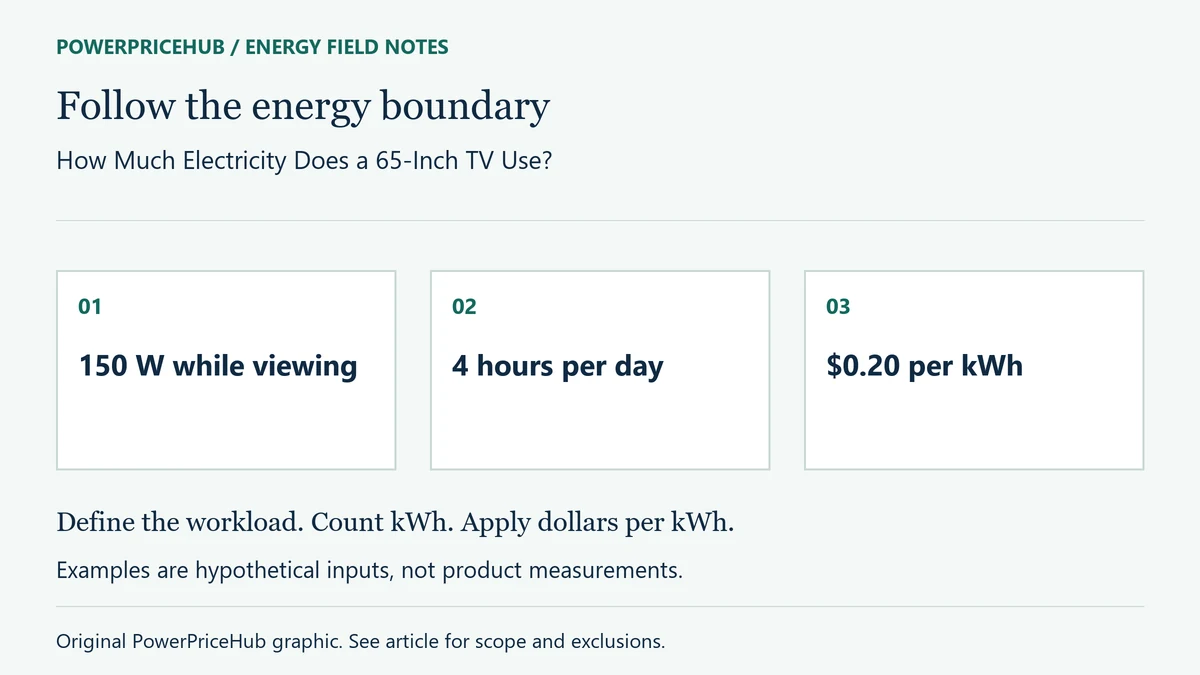
    The table below is a separate hypothetical sensitivity test: three possible on-mode powers, each used four hours a day at $0.20/kWh. It excludes standby and accessories so that the effect of power is visible. None of its rows represents a measurement of the named Samsung model.

    Illustrative scenarioAnnualized kWhAverage month (USD)Annualized cost (USD)
    100 W on-mode146$2.43$29.20
    150 W on-mode219$3.65$43.80
    200 W on-mode292$4.87$58.40
    Hypothetical inputs at $0.20/kWh. Average month = annual estimate ÷ 12; annualization uses 365 days. See the surrounding text for exclusions.

    A real model example, with its limits attached

    The official record, retrieved November 4, 2026, lists 134.53 W in on mode and 0.40 W in standby when the network is not connected. It also lists 251.10 kWh as reported annual energy. Those quantities describe test conditions; they are not interchangeable statements about continuous household use.

    Using the annual figure gives 251.10 × $0.20 = $50.22/year and $4.19 per average month. Using four viewing hours a day plus 20 hours of disconnected-network standby instead gives (134.53 × 4 + 0.40 × 20) ÷ 1,000 = 0.54612 kWh/day. Annualized, that is 199.3338 kWh and $39.87/year.

    The two answers differ because their usage assumptions differ. That is not evidence that the record is wrong. It is a reminder to keep standardized annual estimates separate from a custom schedule. This calculation does not claim that this TV always draws 134.53 W in your home.
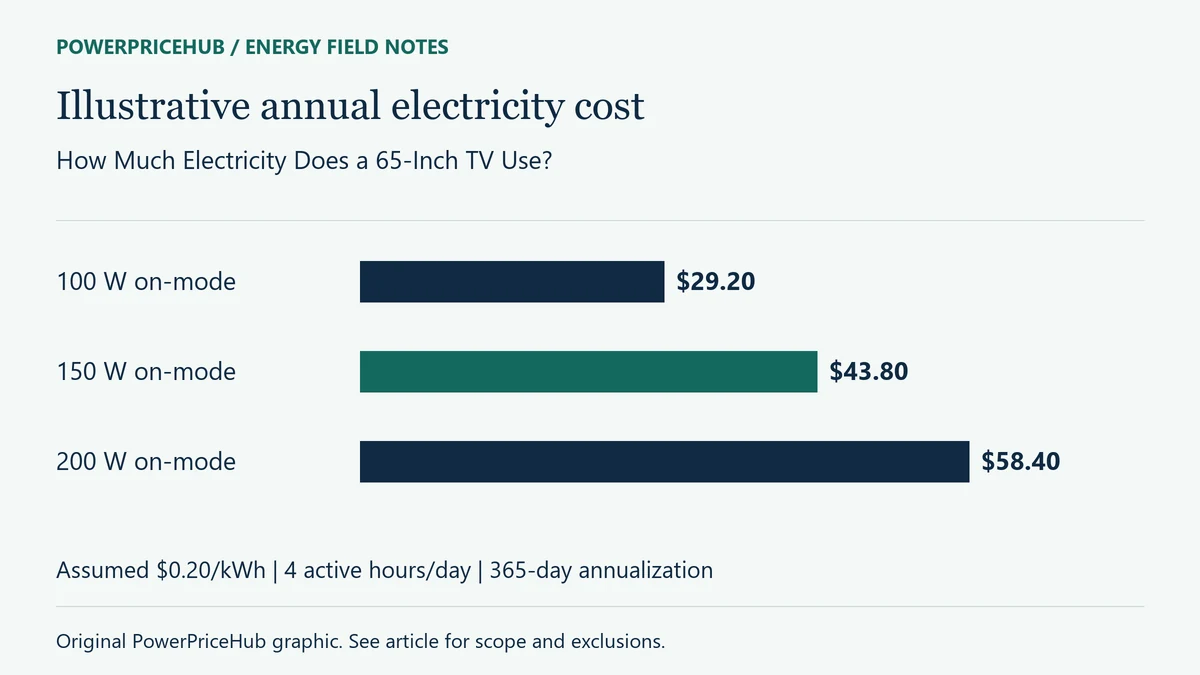
    Illustrative annual electricity costs at $0.20 per kWh: 100 W on-mode costs $29.20; 150 W on-mode costs $43.80; 200 W on-mode costs $58.40. See the table for the same data.
    Original PowerPriceHub calculation chart. Hypothetical scenarios, not measured product performance. The adjacent table provides the same values in text.

    Why picture settings change the answer

    ENERGY STAR describes automatic brightness control as a feature that changes the display’s brightness in response to room lighting. A bright room, different picture mode, or high dynamic range content can therefore make your experience differ from a simple fixed-power scenario. Compare settings using the same content and room conditions rather than one bright scene against one dark scene.

    Display technology matters, but an OLED-versus-LCD label is not enough to calculate a bill. Different models, brightness targets, and content can change the comparison. This article does not rank technologies by an invented universal wattage. Use the exact model’s official record as a starting point and a measured kWh total when you need a household result.

    Keep picture quality requirements consistent. A television set so dim that it is uncomfortable to watch is not delivering the same service as a properly adjusted display. Choose a comfortable home setting and then check the resulting consumption rather than treating the lowest power reading as the only objective.

    Standby is small power multiplied by many hours

    For an illustrative 0.5 W standby load over 20 hours daily, annual standby energy is 3.65 kWh, costing $0.73 at $0.20/kWh. A different assumed 5 W network-active load over the same hours would cost $7.30/year. These are arithmetic examples, not claims about the Samsung record or all smart televisions.

    Quick-start, network wake, updates, and connected devices can affect the low-power state. Follow the manufacturer’s instructions before disconnecting power: updates, recordings, or display maintenance may need normal standby. Check each feature rather than assuming that unplugging every night is always appropriate.

    Measure the entertainment system you actually use

    Decide whether your measurement covers the TV alone or a power strip that also includes a game console, streaming box, soundbar, and receiver. A total-system reading is useful, but it cannot be described as television-only consumption. Label the boundary in your notes.

    Use a suitable meter at an accessible outlet, within its ratings, and compare energy across several normal viewing sessions. Instantaneous wattage can fluctuate with the picture; accumulated kWh is more useful for costing a program or evening. Do not open the television or modify wiring to make a measurement.

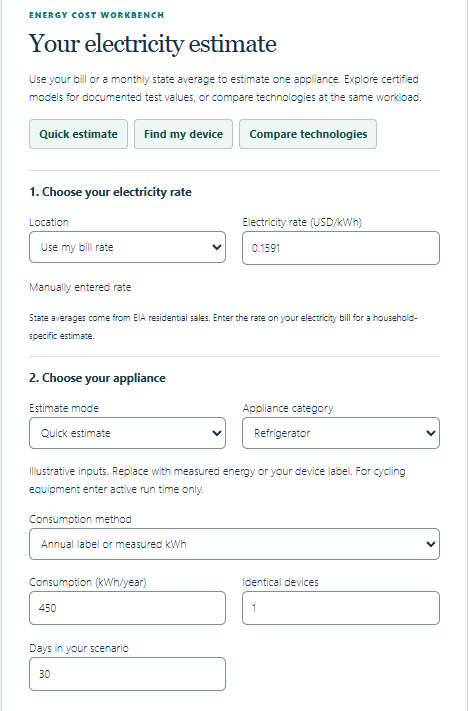
    The model explorer lets you look for documented television data. To use a custom schedule, select active power and enter viewing hours; read the displayed standby assumptions. Our methodology explains the distinction between annual-label and active-power methods, while the bill guide helps choose your electricity price.

    Television electricity questions

    Does a 65-inch TV use a fixed number of watts?

    No. Screen size identifies a class, not a household power measurement. The model, operating mode, brightness, and content all belong in the estimate.

    Should I use annual kWh or watts?

    Use annual kWh for a label-based benchmark. Use watts with hours for a custom schedule. Keep the two methods separate and state which one produced your result.

    Are soundbars included in the TV label?

    Do not assume so. Price each separately supplied accessory or measure the whole system, clearly stating that the result includes more than the television.

    Can I compare EnergyGuide dollars with my bill directly?

    Only after checking the label’s price and usage assumptions. Multiplying annual kWh by your own rate provides a more relevant standardized cost, not an exact household prediction.

    Sources and calculation notes

    Sources checked November 4, 2026. Official sources support the definitions and product information identified in the text; the hypothetical scenarios and charts are original PowerPriceHub calculations, not manufacturer tests.

    ENERGY STAR: television operating features

    EPA certified record: Samsung QN65S90DAF, ID 3354311

    Electricity-rate context: the calculator’s saved EIA residential dataset lists California at 29.75 cents/kWh ($0.2975/kWh) for August 2026, checked November 4, 2026. This is a dated state average, not your household tariff. The $0.20/kWh used in the examples above is an explicit hypothetical input. EIA electricity data and PowerPriceHub methodology.
  • Heat Pump vs. Standard Electric Water Heater: How to Compare Running Costs

    Is a heat pump water heater cheaper to run than a standard electric water heater? In many situations, yes. A conventional electric resistance water heater generates heat directly from electricity, while a heat pump water heater uses electricity to transfer heat from surrounding air into the water.

    Quick answer: In an illustrative scenario requiring 3,000 kWh of useful hot-water heat per year, a standard electric resistance heater would use 3,000 kWh of electricity at an assumed efficiency of 100%. A heat pump operating at a coefficient of performance (COP) of 2.5 would use only 1,200 kWh to deliver the same useful heat, before accounting for tank losses and other real-world factors.

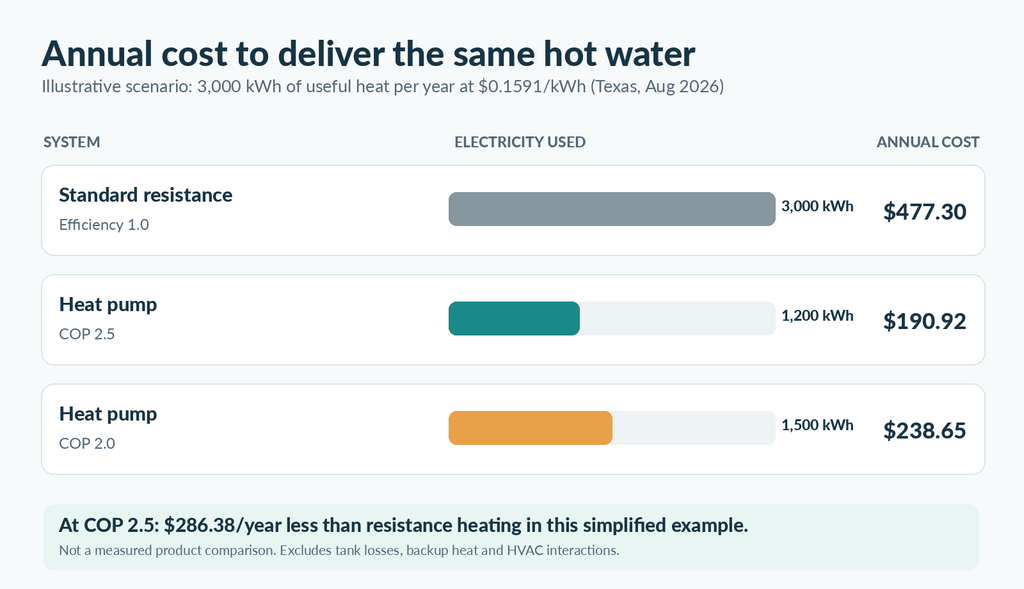
    At the August 2026 Texas average electricity price of $0.1591/kWh, that’s an estimated $477.30 per year for resistance heating versus $190.92 for the heat pump — a difference of $286.38 in this simplified example.

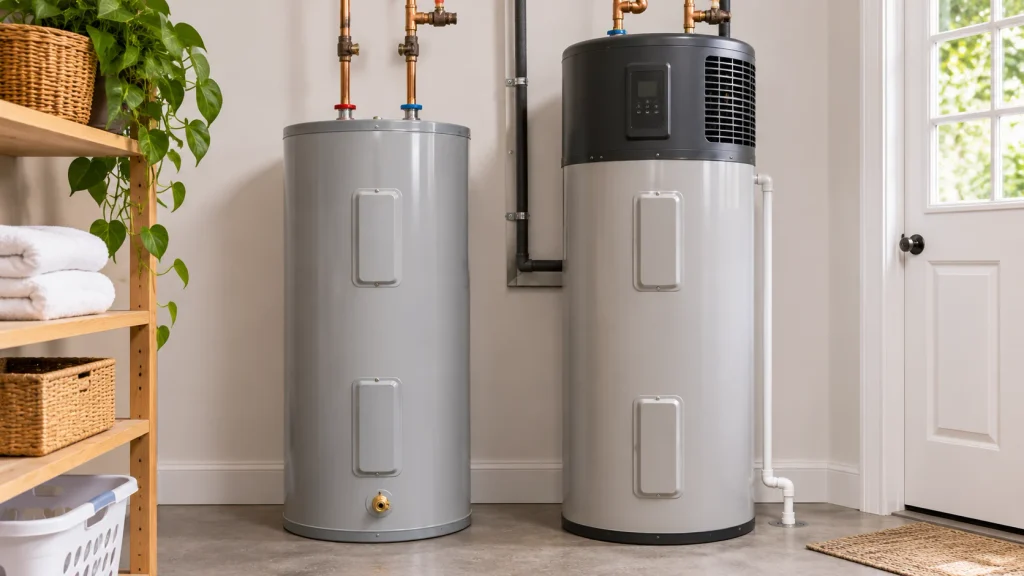
    Standard electric resistance water heater beside a heat pump water heater in a utility room
    Illustrative comparison of a conventional electric resistance water heater and a heat pump water heater. These are not specific product models.

    But lower electricity consumption is only part of the decision. Installation requirements, hot-water demand, local electricity prices, and upfront costs can all affect which system makes sense for your household.

    How does a heat pump water heater differ from a standard electric water heater?

    Both systems use electricity to provide hot water, but they obtain heat differently.

    Standard electric resistance water heater

    A conventional electric water heater uses heating elements inside the tank to warm the water. Electrical energy is converted directly into heat.

    For a simplified comparison, assume that 1 kWh of electricity delivers 1 kWh of useful heat to the water, excluding tank and distribution losses.

    Heat pump water heater

    A heat pump water heater works differently. Instead of generating all its heat directly, it absorbs thermal energy from surrounding air and transfers that heat into the water tank using a refrigeration cycle.

    The result is that the system can deliver more heat energy than the electrical energy it consumes. This doesn’t create energy from nothing: the additional heat comes from the surrounding air.

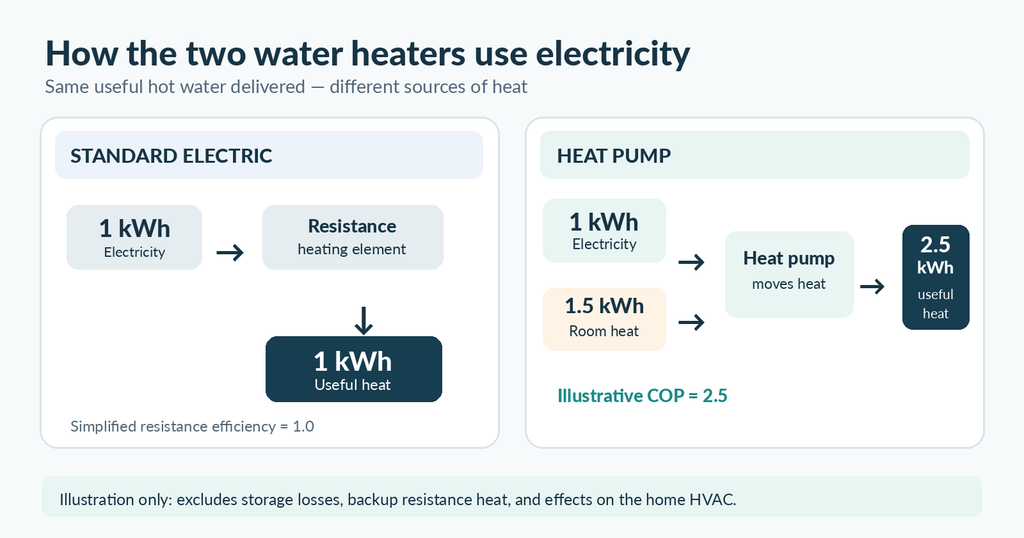
    The diagram below shows the difference using an illustrative heat pump COP of 2.5.

    Diagram comparing resistance heating with a heat pump transferring heat from air into water at an illustrative COP of 2.5
    Simplified energy comparison: resistance heating uses 1 kWh of electricity to deliver 1 kWh of heat, while a heat pump with COP 2.5 uses 1 kWh of electricity plus heat taken from the air to deliver 2.5 kWh of heat.

    The heat pump’s efficiency is often expressed using its coefficient of performance (COP). A COP of 2.5 means the system delivers 2.5 units of heat for every unit of electricity it consumes under the assumed operating conditions.

    Real-world COP changes with air temperature, water temperature, operating mode, and other conditions. Many hybrid heat pump water heaters also include electric resistance elements for periods of high hot-water demand.

    Heat pump vs. electric water heater: annual running cost comparison

    To compare the technologies fairly, both water heaters must deliver the same amount of useful hot water.

    Let’s assume a household needs 3,000 kWh of useful water-heating energy per year. We will compare an idealized resistance system with heat pumps operating at two different COP values.

    For this example, we assume identical hot-water demand, inlet water temperature, and temperature settings. We exclude standby losses, backup resistance operation, installation differences, and interactions with home heating or cooling.

    All three scenarios use the August 2026 Texas residential average electricity price of $0.1591 per kWh, published by the U.S. Energy Information Administration.

    Water heater typeUseful heat/yearElectricity/yearAnnual cost
    Electric resistance3,000 kWh3,000 kWh$477.30
    Heat pump (COP 2.5)3,000 kWh1,200 kWh$190.92
    Heat pump (COP 2.0)3,000 kWh1,500 kWh$238.65

    The chart below illustrates how efficiency changes electricity costs while the useful hot-water demand remains the same.

    Annual electricity cost chart comparing 477.30 dollars for resistance heating, 190.92 dollars for a heat pump at COP 2.5, and 238.65 dollars at COP 2.0
    Illustrative annual electricity costs at $0.1591/kWh for 3,000 kWh of useful hot-water demand. The comparison excludes tank losses, backup resistance use, and interactions with the home’s heating and cooling systems.

    How much electricity could a heat pump save?

    In the COP 2.5 scenario, the heat pump uses 1,200 kWh instead of 3,000 kWh. That’s 1,800 kWh less electricity per year, a 60% reduction in this simplified comparison.

    At the Texas example rate, the annual difference is:

    1,800 kWh × $0.1591 = $286.38 per year

    If the heat pump operates at COP 2.0 instead, it needs 1,500 kWh per year, increasing its estimated annual electricity cost to $238.65.

    These results demonstrate how efficiency affects running costs. They are not guaranteed savings for a specific household or water heater.

    Is a heat pump water heater worth the higher upfront cost?

    A heat pump water heater may use less electricity, but it can also cost more to purchase and install than a conventional electric resistance tank.

    To evaluate whether the upgrade is worthwhile, compare the additional upfront cost with the expected annual electricity savings.

    Simple payback period = Additional upfront cost ÷ Annual electricity savings

    For example, suppose a heat pump water heater costs $1,000 more to purchase and install than a comparable resistance model. Using the illustrative annual savings of $286.38 from our COP 2.5 scenario:

    $1,000 ÷ $286.38 = approximately 3.5 years

    This is a hypothetical payback calculation, not an actual installation quote. Real payback depends on equipment prices, installation work, hot-water usage, electricity rates, maintenance, available incentives, and actual seasonal efficiency.

    Check available utility and local incentives before making a purchase, and compare written installation estimates for both systems.

    Which water heater is easier to install?

    A standard electric resistance water heater generally has simpler air-space requirements because it doesn’t rely on surrounding air to collect heat.

    A heat pump water heater needs additional consideration. Before choosing one, evaluate the following:

    • Available air space: The heat pump needs sufficient airflow or an approved ducting arrangement. The exact requirements depend on the model.
    • Condensate drainage: Heat pump operation can produce condensate that needs to be drained properly.
    • Temperature: Cold surrounding air can reduce performance or cause some models to use backup resistance heating.
    • Noise: Heat pump models contain fans and compressors, so installation location matters.
    • Hot-water demand: Compare tank capacity and first-hour rating, especially for households with several back-to-back showers.
    • Electrical and plumbing work: Check the manufacturer’s specifications and obtain professional installation advice.

    ENERGY STAR advises checking each manufacturer’s installation instructions, ventilation requirements, and first-hour rating before choosing a model.

    Can I compare real water heaters using their EnergyGuide labels?

    Yes. In fact, for specific water heater models, their published annual electricity consumption figures are often more useful than assuming one COP value for every installation.

    Look for the yellow EnergyGuide label or the manufacturer’s certified energy information. When comparing models, use the same hot-water draw-size class and consider comparable capacity and delivery performance.

    If a label lists annual electricity consumption directly in kWh, multiply that number by your electricity rate:

    Annual electricity cost = Annual kWh × Electricity rate ($/kWh)

    Important: Do not divide a certified annual-kWh figure by COP again. The tested annual energy value already incorporates the equipment’s performance under the applicable test procedure.

    You may also see a Uniform Energy Factor (UEF) rating. UEF is a standardized water-heater efficiency measure and is not necessarily equal to the COP used in our simplified example. Annual kWh and comparable test conditions are especially useful when estimating costs from real labels.

    Calculate your water heater’s running cost with PowerPriceHub

    Now that you understand the difference between resistance heating and heat pumps, you can estimate the electricity cost of either system using your own electricity rate.

    To reproduce our simplified Texas comparison in PowerPriceHub, choose an annual-kWh consumption method and calculate each scenario separately:

    Electricity rate0.1591 USD/kWh
    Electric resistance example3,000 kWh/year
    Heat pump example (COP 2.5)1,200 kWh/year
    Number of devices1

    These are hypothetical annual consumption values, not certified model specifications. For your actual water heater, use its published annual kWh or a reliable measurement when available.

    Need help finding your electricity rate? See our guide on how to calculate an appliance’s electricity cost from your bill.

    Frequently asked questions

    Do heat pump water heaters really use less electricity?

    They generally can. Heat pump water heaters transfer heat from surrounding air instead of generating all the heat directly. Actual efficiency depends on operating conditions, settings, and how often backup resistance elements are used.

    Does a heat pump water heater work in cold weather?

    Yes, within the conditions supported by the specific model, but colder surrounding air can reduce efficiency. Some hybrid systems may rely more heavily on electric resistance heating when air temperatures are low or hot-water demand is high.

    Can a heat pump water heater cool the room?

    Yes. It removes heat from surrounding air, which can make the installation space cooler and drier. That may be beneficial in some conditions but can increase space-heating demand in colder periods.

    How long does it take for a heat pump water heater to pay for itself?

    There is no universal payback period. Calculate the difference in purchase and installation costs, account for any eligible incentives, and divide the net extra cost by your expected annual savings. Real-world efficiency and electricity prices affect the result.

    Which electric water heater should you choose?

    A heat pump water heater can significantly reduce electricity consumption when installed in suitable conditions and operated efficiently. However, a standard electric resistance model may be simpler to install in spaces where airflow, condensate drainage, or budget constraints make a heat pump impractical.

    Before buying, compare annual energy use, installation requirements, hot-water delivery, and total ownership costs — not just the electricity savings shown in an example.

    Use PowerPriceHub to estimate how much each option could cost at your electricity rate.

    For more details about the assumptions behind our estimates, read our calculation methodology.

    Sources

  • How Much Does an Electric Oven Cost to Run?

    How Much Does an Electric Oven Cost to Run?

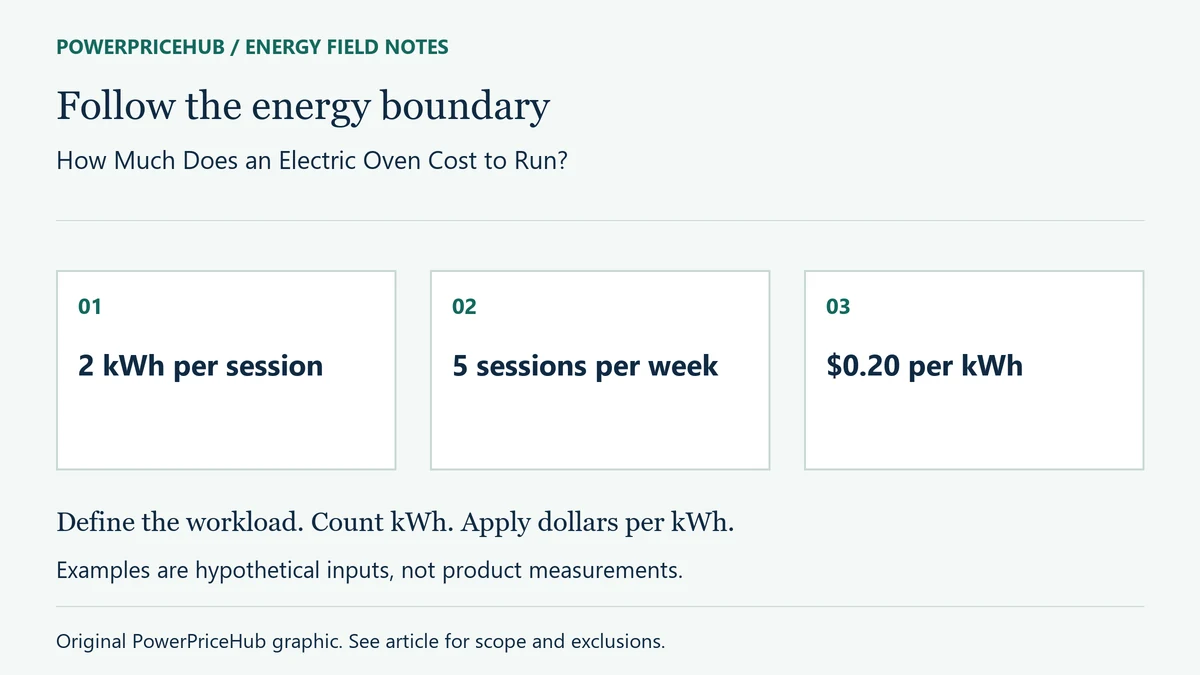
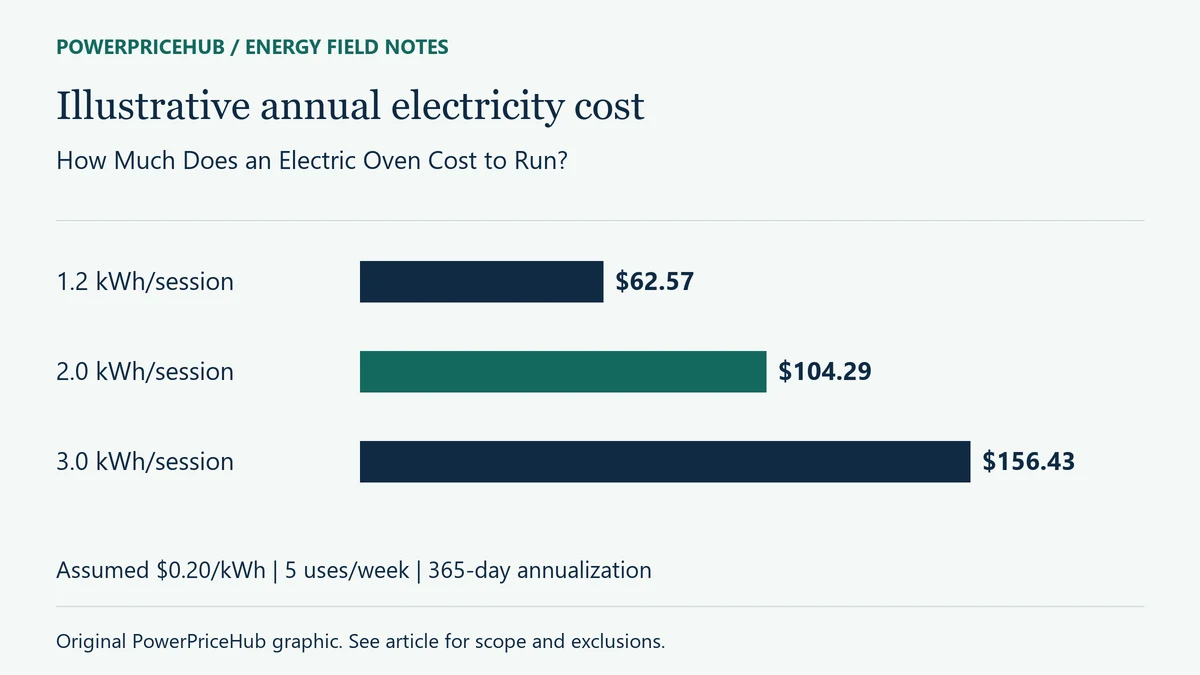
    An electric oven that uses a hypothetical 2 kWh for one cooking session costs $0.40 at an illustrative $0.20/kWh. Five sessions per week annualize to 521.429 kWh and $104.29/year. That session figure should include the parts you intend to count, such as preheating and cooking. It is not a measurement of your oven or a claim that every meal uses the same energy.

    The rating on a heating element is a power figure, while a meal’s consumption is energy accumulated over time. Thermostat cycling, preheat duration, temperature, cooking time, and oven size all affect how the two relate. Multiplying full rated power by the entire time displayed on a kitchen timer can misrepresent actual use.

    Quick answer: estimate the complete cooking session

    For a useful cost per meal, start when the oven begins preheating and stop at your chosen boundary after cooking. State whether standby and a cooling fan afterward are included. If an oven and cooktop share a circuit-level reading, separate their use or call the result a combined cooking total.

    The comparison table uses hypothetical session energies, five weekly sessions, and an assumed $0.20/kWh. The rows are not efficiency classes or measured products. They exclude the cooktop, ventilation, purchase price, and any household cooling response to heat released into the kitchen.

    Illustrative scenarioAnnualized kWhAverage month (USD)Annualized cost (USD)
    1.2 kWh/session312.857$5.21$62.57
    2.0 kWh/session521.429$8.69$104.29
    3.0 kWh/session782.143$13.04$156.43
    Hypothetical inputs at $0.20/kWh. Average month = annual estimate ÷ 12; annualization uses 365 days. See the surrounding text for exclusions.

    Why the element rating is not the meal’s kWh

    A conventional electric oven uses electric resistance heat; the Department of Energy distinguishes this appliance type from other cooking products. During a session, the elements may operate at different times as the oven heats and maintains temperature. The full rated input does not have to persist continuously.

    A simplified hypothetical example makes the distinction clear. A 3 kW element energized for a total of 40 minutes uses 2 kWh. An hour-long session in which that occurs does not automatically use 3 kWh. Conversely, a long preheat or additional heating elements can change the total. Only suitable measurement or documented session energy establishes the particular result.

    The calculation is not a recommendation to bypass the thermostat or change electrical controls. Follow normal operating instructions. An energy estimate should never require opening the appliance, exposing wiring, or modifying its safety systems.

    Separate preheating from holding temperature

    Suppose preheating uses an assumed 0.5 kWh and the following cooking period uses 1.5 kWh. The meal total is 2 kWh and costs $0.40 at $0.20/kWh. If a second compatible dish can be cooked during that same already-planned session, allocate the shared energy thoughtfully rather than assigning the full preheat to each dish.

    Batch cooking does not guarantee a fixed saving. Extra food can change cooking time, rack arrangement, temperature recovery, or the required program. Food safety and recipe requirements come first. The meaningful comparison is energy for the complete acceptable meal, not a lower reading obtained by undercooking food.

    Illustrative annual electricity costs at $0.20 per kWh: 1.2 kWh/session costs $62.57; 2.0 kWh/session costs $104.29; 3.0 kWh/session costs $156.43. See the table for the same data.
    Original PowerPriceHub calculation chart. Hypothetical scenarios, not measured product performance. The adjacent table provides the same values in text.

    Temperature, time, and opening the door

    Higher settings and longer sessions change the heating task, but there is no universal conversion from an extra degree to a dollar amount for every oven. Insulation, control behavior, food load, and kitchen conditions all matter. Do not publish a model-specific saving without appropriate documentation or repeatable measurement.

    Use the window and oven light when they let you check progress appropriately instead of repeatedly opening the door. Keep seals and accessible surfaces maintained according to the manual. Do not use cleaning methods that damage a door seal or obstruct ventilation in pursuit of a small operating-cost reduction.

    Self-cleaning is a separate operating task. If you want a yearly cooking budget, record any cleaning-cycle energy separately rather than spreading an invented allowance across meals. Likewise, a broil session should not automatically inherit a bake-session figure.

    Full-size oven versus a smaller cooking appliance

    A countertop oven, microwave, or another appliance may suit some meals, but the comparison must deliver the same acceptable food outcome. Do not compare reheating one portion with roasting a large meal and call the difference an efficiency result. Match the food amount, starting condition, desired finish, and food-safety requirement.

    For a hypothetical comparison, one suitable alternative might use 0.6 kWh for a meal that uses 2 kWh in another appliance. At $0.20/kWh, the energy-cost difference is $0.28 for that meal. Those values are assumptions for arithmetic, not test results or a general claim about countertop appliances.

    Check usable capacity before buying a second appliance. Purchase price, counter space, storage, and frequency of use belong in the decision. A rarely used device may not recover its purchase price through electricity savings alone, even if it uses less energy for one chosen task.

    Find a safe basis for your household estimate

    Many built-in electric ovens are hardwired or use a supply unsuitable for an ordinary 120-volt plug-in meter. Do not use improvised adapters or work inside an electrical panel. A qualified professional can advise on appropriate circuit-level monitoring; otherwise use model documentation and label the calculation’s limits.

    When using a whole-home energy display, other appliances can overlap with the oven. A rise in the home’s total demand is not automatically oven-only consumption. Isolate the time period and account for other loads, or describe the reading as a household observation rather than a precise appliance measurement.

    Use the electricity calculator for a documented power-and-time scenario or an energy-per-session estimate. Our bill-rate guide explains the variable electricity price, and methodology explains the units and rounding used in the examples.

    Electric oven cost questions

    Does a 3,000 W oven use 3 kWh every hour?

    Only if it actually draws that power continuously for the full hour. Thermostat cycling and different operating phases can make session energy different from that rated-power scenario.

    Should preheating be counted?

    Yes, if you want the full electricity cost of a meal that requires preheating. State your measurement boundary so the session can be compared fairly with another appliance.

    Does convection always save a fixed percentage?

    No universal percentage is assumed here. A different program may change cooking time and temperature, but the actual energy difference needs matching meal conditions and suitable evidence.

    Are self-cleaning and the cooktop included?

    Not in the illustrative cooking-session table. Add separately documented energy for those functions if you want a total cooking-appliance budget.

    Sources and calculation notes

    Sources checked November 4, 2026. Official sources support the definitions and product information identified in the text; the hypothetical scenarios and charts are original PowerPriceHub calculations, not manufacturer tests.

    DOE: household cooking-product definitions

    DOE: consumer guide to kitchen appliances

    Electricity-rate context: the calculator’s saved EIA residential dataset lists California at 29.75 cents/kWh ($0.2975/kWh) for August 2026, checked November 4, 2026. This is a dated state average, not your household tariff. The $0.20/kWh used in the examples above is an explicit hypothetical input. EIA electricity data and PowerPriceHub methodology.
  • How Much Does It Cost to Run a Window Air Conditioner?

    How much does a window air conditioner add to your electricity bill? The answer depends on its energy consumption, how long it runs, and the electricity rate you pay.

    Quick answer: The ENERGY STAR-certified BLACK+DECKER BD08NWES, an 8,000 BTU/h window air conditioner, has an estimated annual electricity use of 400 kWh. At the August 2026 Texas residential average electricity price of $0.1591/kWh, that works out to approximately $63.64 for the standardized test-year usage.

    But how much would it cost to run an air conditioner for one afternoon, eight hours, or an entire month? Those questions require a different calculation. Let’s look at real appliance data, practical examples, and how to estimate your own cooling costs.

    White window air conditioner installed in a bright bedroom
    A window air conditioner’s electricity cost depends on its electrical power consumption, cooling workload, and local electricity rate. Illustrative image, not the specific BLACK+DECKER model.

    Already know how much electricity your air conditioner uses? Try the free PowerPriceHub electricity calculator to estimate costs using your own rate.

    How much electricity does an 8,000 BTU window air conditioner use?

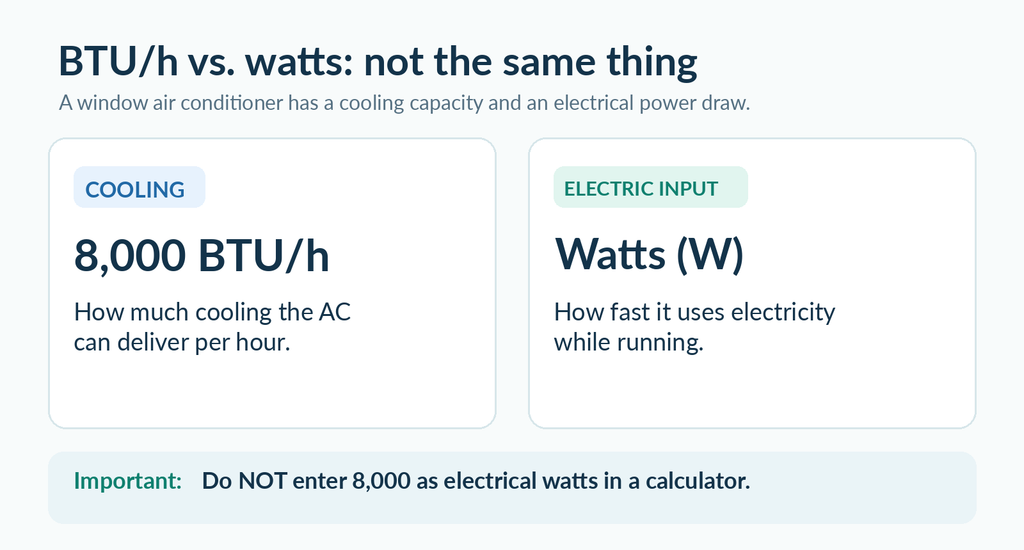
    One of the most common mistakes when calculating air conditioner costs is confusing BTU/h with watts.

    An air conditioner rated at 8,000 BTU/h does not necessarily consume 8,000 watts of electricity.

    BTU/h measures how much heat an air conditioner can remove per hour. Watts measure electrical power drawn from the outlet. They’re related through the appliance’s efficiency, but they describe different things.

    The following illustration explains the difference.

    Infographic explaining the difference between air conditioner cooling capacity in BTU per hour and electrical power consumption in watts
    BTU/h describes cooling capacity, while watts describe electrical power consumption. Never enter an air conditioner’s BTU/h rating as watts in an electricity cost calculator.

    BTU/h vs. watts vs. kWh

    • BTU/h: Measures cooling capacity, or how quickly the air conditioner removes heat.
    • Watts (W): Measure the electrical power the unit draws at a particular moment.
    • Kilowatt-hours (kWh): Measure electricity consumed over time and are used to calculate electricity costs.

    For example, a window AC drawing 800 watts continuously for five hours would use 4 kWh. However, 800 watts is an illustrative input, not a verified operating wattage for the BLACK+DECKER BD08NWES.

    If you know your unit’s actual power consumption, you can estimate its energy use with this formula:

    Energy (kWh) = Electrical watts ÷ 1,000 × Operating hours

    How much does it cost to run a window AC for 2, 5, or 8 hours?

    Let’s use a hypothetical window air conditioner drawing a constant 800 watts and the August 2026 Texas average residential electricity rate of $0.1591/kWh.

    These calculations show how energy costs change with operating time. They are not measurements of the BLACK+DECKER model.

    Operating time at 800 WElectricity usedEstimated cost
    1 hour0.8 kWh$0.13
    2 hours1.6 kWh$0.25
    5 hours4.0 kWh$0.64
    8 hours6.4 kWh$1.02

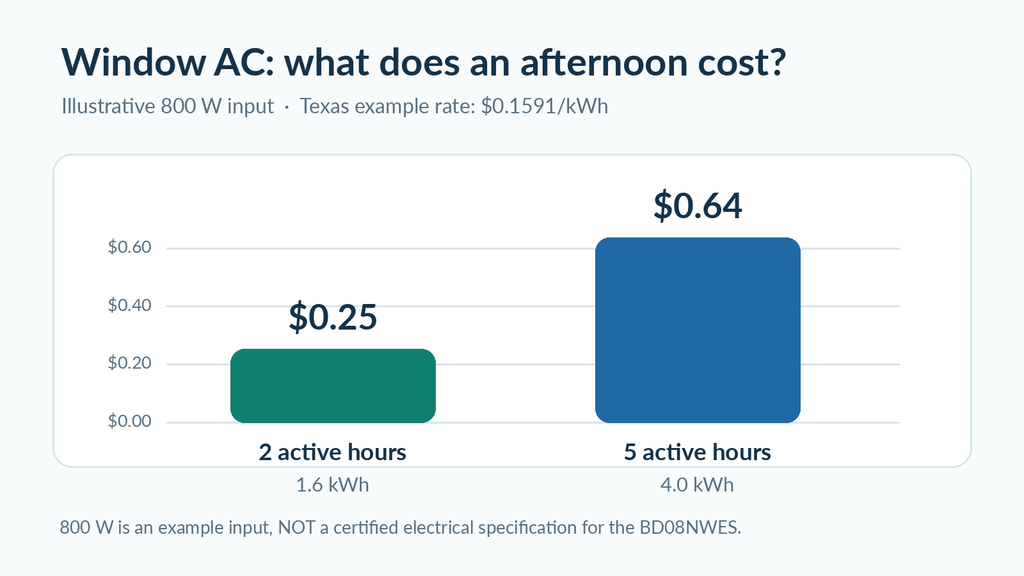
    The chart below highlights the difference between two and five hours of operation at the same assumed power draw.

    Chart showing estimated window air conditioner electricity costs of 25 cents for two hours and 64 cents for five hours using an illustrative 800 watt power draw
    Illustrative electricity costs at $0.1591/kWh: two hours at 800 W use 1.6 kWh ($0.25), while five hours use 4 kWh ($0.64).

    For the five-hour example, the calculation is:

    800 ÷ 1,000 × 5 = 4 kWh

    4 kWh × $0.1591 = $0.64

    Remember that actual electricity use may be lower or higher depending on compressor speed, room conditions, fan operation, and the appliance’s measured electrical demand.

    How much does a window air conditioner cost per year?

    For a longer-term estimate, an ENERGY STAR-certified annual electricity consumption figure can be more useful than guessing how many hours the compressor runs.

    The BLACK+DECKER BD08NWES has the following documented specifications:

    ModelBLACK+DECKER BD08NWES
    TypeWindow air conditioner
    Cooling capacity8,000 BTU/h
    Certified annual energy use400 kWh/year
    CompressorVariable speed
    Combined Energy Efficiency Ratio (CEER)15.0

    These specifications are documented in ENERGY STAR certification record 3387785.

    To estimate annual electricity costs, multiply the standardized annual consumption by the electricity rate:

    400 kWh × $0.1591 = $63.64 per year

    At the August 2026 California residential average of $0.2975/kWh, the same standardized workload would cost approximately $119.00 per year.

    Important: The 400 kWh figure represents standardized annual test consumption, not a guarantee of what your unit will use during an actual year. Hot weather, operating schedules, insulation, and temperature settings can change consumption significantly.

    What happens if my window AC is switched on all day?

    Leaving an air conditioner switched on for eight hours doesn’t necessarily mean its compressor runs at full power for eight hours.

    Some air conditioners cycle their compressors on and off. Inverter models can also adjust compressor speed depending on how much cooling is needed.

    The BLACK+DECKER BD08NWES uses a variable-speed compressor, meaning its electrical demand can change during operation.

    For a more accurate estimate, use actual kWh readings if your unit provides them, or measure consumption over a representative cooling period using a compatible energy monitor.

    For example, if a compatible meter records 6 kWh over a day, that day’s estimated electricity cost at $0.1591/kWh would be approximately $0.95.

    That measured figure reflects actual energy use during the observation period rather than assuming constant compressor power.

    How can I reduce my window air conditioner’s electricity cost?

    You don’t always need to replace your air conditioner to improve its efficiency. A few practical changes may reduce unnecessary cooling demand.

    • Choose an appropriate cooling capacity: An oversized or undersized unit may not cool the room efficiently or comfortably.
    • Keep filters clean: Follow the manufacturer’s filter-cleaning recommendations.
    • Reduce direct sunlight: Close blinds or curtains during hot, sunny periods when practical.
    • Seal gaps around the installation: Prevent unnecessary air leakage around the window unit.
    • Use sensible thermostat settings: Avoid unnecessarily low temperatures that increase cooling demand.
    • Compare efficiency ratings: When choosing between appropriately sized units, check certified annual energy consumption and CEER.

    Actual savings vary with the room, weather, installation, and how the air conditioner is used.

    Calculate your own window air conditioner electricity cost

    National and state electricity averages are useful starting points, but your own utility rate may be very different.

    With PowerPriceHub, you can enter your electricity rate and appliance consumption to estimate running costs without doing the calculations manually.

    For example, try using these values for the certified BLACK+DECKER annual consumption:

    • Appliance: Room air conditioner
    • Consumption method: Annual label or measured kWh
    • Annual electricity use: 400 kWh
    • Electricity rate: 0.1591 USD/kWh
    • Identical devices: 1

    Using those inputs gives an estimated annual cost of $63.64. Replace them with your appliance’s actual energy consumption and the electricity rate from your bill.

    Frequently asked questions

    Does an 8,000 BTU air conditioner use 8,000 watts?

    No. The 8,000 BTU/h figure represents cooling capacity, not electrical power consumption. To calculate electricity use, find electrical watts or measured kWh.

    Is it expensive to run a window AC all night?

    The cost depends on electricity consumption over the night. A thermostat-controlled or inverter unit may reduce compressor power as the room cools, so eight hours switched on doesn’t necessarily equal eight hours at full electrical power.

    Can I use annual EnergyGuide consumption to calculate one day’s cost?

    You can divide an annual value by 365 to obtain a mathematical daily average, but this does not predict the cost of a particular hot day. Cooling electricity use varies with the season and weather.

    Should I choose the window AC with the lowest annual kWh?

    Not automatically. First choose a unit with cooling capacity suitable for your room. Then compare energy consumption and efficiency among models that provide similar cooling performance.

    Find out how much your air conditioner really costs

    The easiest way to estimate your window air conditioner’s electricity cost is to use its documented or measured energy consumption and the electricity rate you actually pay.

    Enter your numbers into PowerPriceHub to estimate your running costs.

    Need help finding your electricity rate? Read how to calculate an appliance’s electricity cost from your bill or learn more about our calculation methodology.

    Sources

  • How Much Does a 1,500-Watt Space Heater Cost to Run?

    How much does it cost to run a 1,500-watt space heater? Whether you’re heating a bedroom, home office, or small living space, the answer depends on how long the heater actually runs and how much you pay for electricity.

    Quick answer: A 1,500W electric space heater uses 1.5 kilowatt-hours (kWh) for every hour it operates at full power. At the August 2026 Texas average residential electricity rate of $0.1591/kWh, that’s approximately $0.24 per hour.

    Run it at full power for two hours a day over 30 days, and your estimated electricity cost is $14.32. In California, using its August 2026 residential average rate, the same usage costs approximately $26.78.

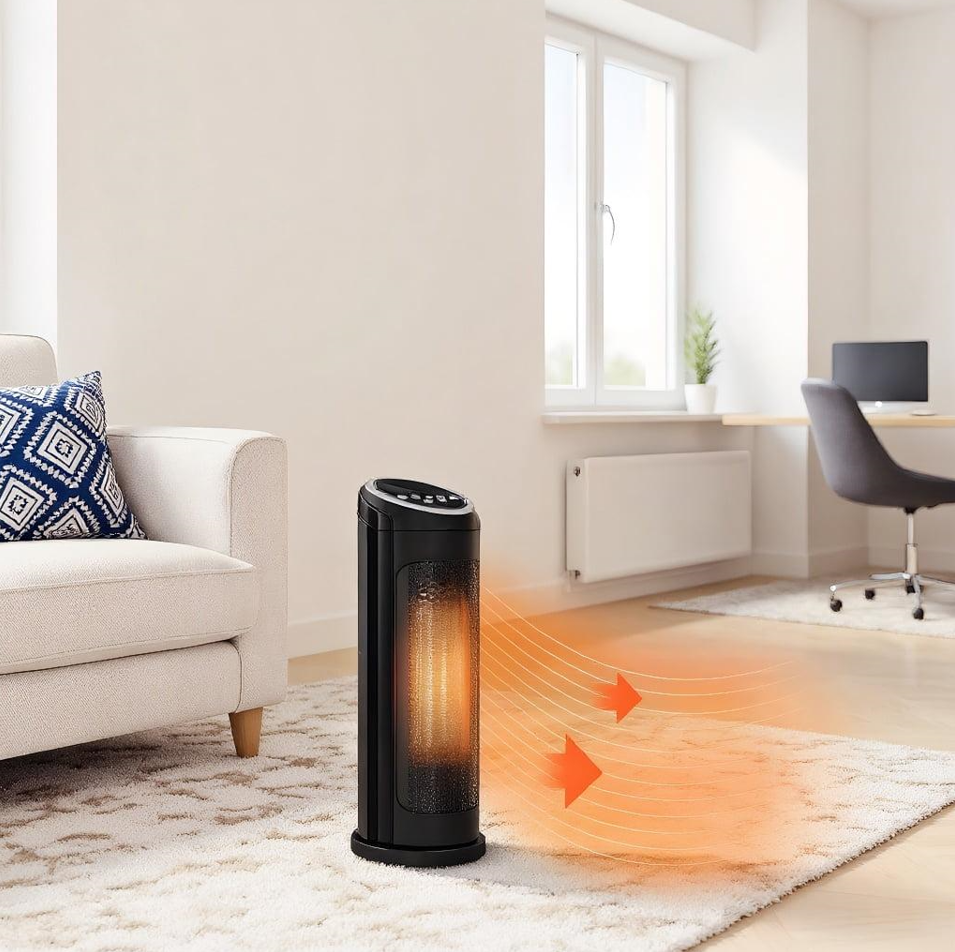
    Portable electric space heater used to warm a room
    A 1,500-watt space heater consumes 1.5 kWh per hour while operating continuously at its full rated power.

    Below, we’ll break down hourly and monthly heating costs, explain how thermostats affect electricity consumption, and show you how to calculate your own costs using PowerPriceHub.

    Want a personalized estimate? Calculate your space heater’s electricity cost using your own electricity rate and daily operating hours.

    How much electricity does a 1,500W space heater use?

    Electricity consumption is measured in kilowatt-hours (kWh). To calculate how much electricity a heater uses, convert its power from watts to kilowatts and multiply by its operating time.

    Energy used (kWh) = Watts ÷ 1,000 × Hours at that power

    For a 1,500-watt space heater operating continuously at full power:

    • 1 hour: 1.5 kWh
    • 2 hours: 3 kWh
    • 4 hours: 6 kWh
    • 8 hours: 12 kWh

    These are full-power examples. If the heater has a thermostat that switches the heating element on and off, its actual consumption may be lower. Some heaters also have fans or controls that consume electricity.

    How much does a 1,500W heater cost per month?

    Electricity prices vary depending on your state, utility company, and electricity plan. That’s why two households using the same heater for the same number of hours can have different bills.

    According to the U.S. Energy Information Administration (EIA), the August 2026 average residential electricity prices were:

    • Texas: $0.1591/kWh (15.91 cents)
    • California: $0.2975/kWh (29.75 cents)

    Using those rates, here’s how much a 1,500-watt heater would cost over 30 days at different daily operating times.

    Daily hours at full power30-day energy useTexas costCalifornia cost
    1 hour45 kWh$7.16$13.39
    2 hours90 kWh$14.32$26.78
    4 hours180 kWh$28.64$53.55

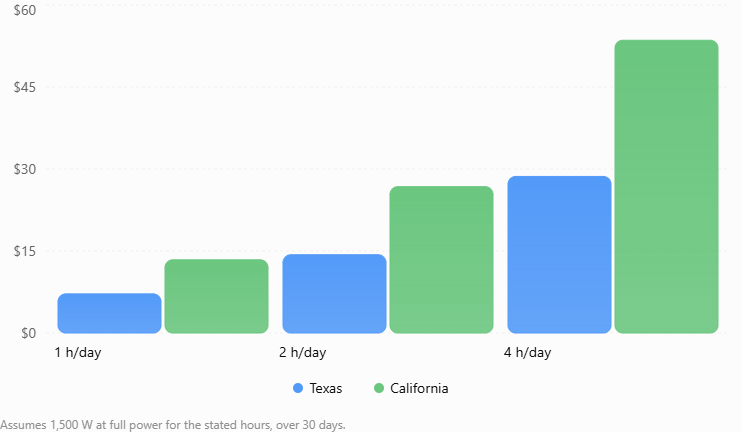
    The chart below makes the difference easier to visualize. Notice how increasing the daily operating time increases energy consumption and running costs.

    Bar chart comparing estimated monthly electricity costs of a 1500 watt space heater in Texas and California for different daily operating hours
    Estimated 30-day electricity costs for a 1,500W space heater operating at full power for 1, 2, or 4 hours per day. Based on August 2026 state-average residential electricity rates.

    Example: Running a 1,500W heater for two hours every day over 30 days uses:

    1,500 ÷ 1,000 × 2 × 30 = 90 kWh

    At the Texas example rate, 90 × $0.1591 = $14.32 for 30 days.

    If you have two identical heaters following the same schedule, their combined energy use would be 180 kWh over 30 days, costing approximately $28.64 at the same Texas rate.

    These estimates use state-average residential rates from one month and assume full-power operation for the specified hours. Your actual rate and electricity consumption may differ.

    Does a space heater always consume 1,500 watts?

    No. A 1,500-watt rating tells you the heater’s power consumption at its rated full-power setting. It doesn’t necessarily mean the heating element draws 1,500 watts every minute the heater is switched on.

    Many electric heaters include a thermostat that switches the heating element off when the room reaches the selected temperature and turns it on again as the room cools.

    Example: A heater switched on for eight hours

    Imagine a 1,500W heater remains switched on for eight hours, but its heating element operates at full power for only three of those hours.

    The heating element’s full-power consumption would be:

    1.5 kW × 3 hours = 4.5 kWh

    That’s different from the 12 kWh it would use if the heating element ran at full power for all eight hours. Fans, electronic controls, or lower-power operating modes can affect the actual total.

    Lowering the thermostat can reduce electricity consumption if it reduces the heating element’s operating time, but the savings depend on the room, outside temperature, insulation, and heater design.

    Is it safe to leave a space heater on overnight?

    Although it’s possible to calculate the electricity use associated with eight hours of operation, that doesn’t mean leaving a portable heater running while you sleep is safe.

    The U.S. Consumer Product Safety Commission recommends turning portable heaters off while sleeping. Keep them at least three feet away from combustible materials such as bedding, curtains, and furniture, and plug electric heaters directly into wall outlets rather than extension cords or power strips.

    Always follow the manufacturer’s safety and operating instructions for your specific heater.

    Will using a space heater lower my heating bill?

    A portable space heater can be useful for heating a particular area, but it doesn’t automatically reduce your total household heating expenses.

    If you add a space heater while leaving your central heating system operating at the same settings, you’re adding electricity consumption rather than necessarily replacing other heating costs.

    Potential savings depend on whether you’re able to reduce central heating in other areas, your existing heating system’s efficiency, and the amount of useful heat your room needs.

    For example, a heat pump can deliver more useful heat per kWh of electricity than conventional electric resistance heating under suitable conditions. To compare technologies fairly, use the same amount of useful heat delivered rather than comparing electricity consumption alone.

    You can explore heating technology comparisons using the PowerPriceHub electricity calculator.

    Calculate your space heater’s electricity cost with PowerPriceHub

    Now that you know how watts, operating hours, and electricity rates work together, you can calculate your own heating costs without doing the math manually.

    The free PowerPriceHub calculator lets you enter an appliance’s electricity consumption, daily operating time, and your own electricity rate to estimate running costs.

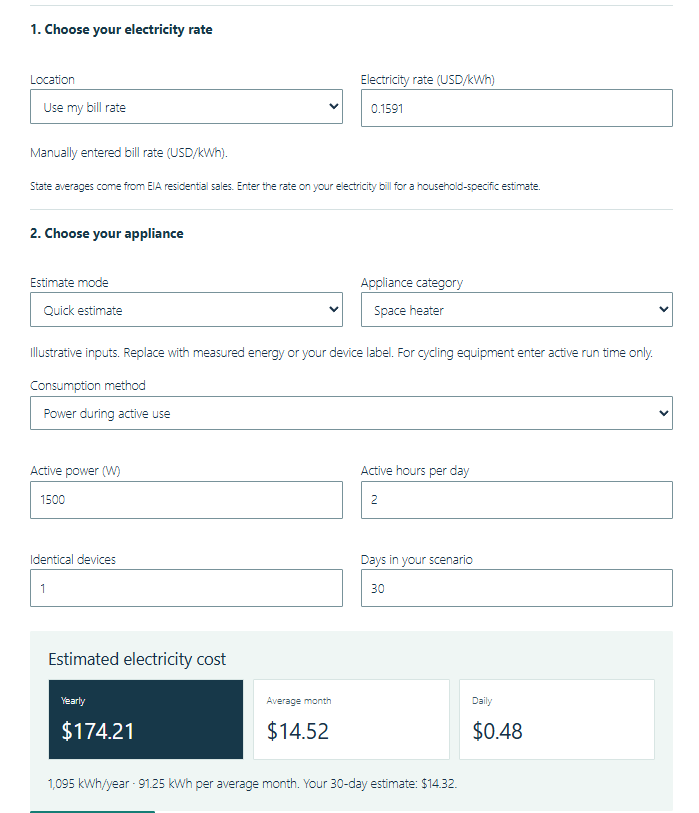
    Here’s a screenshot of the calculator. To reproduce our Texas example, use these values:

    • Electricity rate: 0.1591 USD/kWh
    • Appliance: Space heater
    • Power: 1,500 watts
    • Full-power operating time: 2 hours per day
    • Days: 30
    • Identical heaters: 1
    PowerPriceHub electricity cost calculator for estimating space heater running costs using watts hours and electricity rate
    PowerPriceHub electricity cost calculator. Enter your own heating schedule and electricity rate to estimate your running costs.

    Under the example assumptions, operating one 1,500W heater at full power for two hours per day over 30 days costs approximately $14.32 at the Texas average rate used in this guide.

    Replace the example electricity price with the rate from your own bill and change the operating hours to match how you use your heater.

    Frequently asked questions

    How much does a 1,500W heater cost to run for one hour?

    At full power, it uses 1.5 kWh. That costs approximately $0.24 at $0.1591/kWh or $0.45 at $0.2975/kWh. Your electricity rate determines the exact estimate.

    How much electricity does a 1,500W heater use in eight hours?

    It would use 12 kWh if it operated continuously at full power for all eight hours. A thermostat-controlled heater may use less if the heating element cycles off. Portable heaters should be turned off while sleeping.

    Will a lower thermostat setting reduce electricity consumption?

    It can, if the lower temperature setting reduces the time the heating element is active. Actual savings depend on the heater and the conditions of the room.

    Is it cheaper to run a space heater or central heating?

    It depends on your central heating system, fuel prices, the area you need to heat, and how much central heating you can replace. A portable electric heater is not automatically the cheaper option.

    Find out what your heater really costs

    A 1,500W space heater can have a very different running cost depending on how long its heating element operates and the price of electricity in your home.

    Use your own electricity rate and heating schedule to estimate your costs with PowerPriceHub.

    Need help finding the correct electricity rate? Read how to calculate an appliance’s electricity cost from your bill, or review our calculation methodology.

    Sources

  • How Much Electricity Does a Refrigerator Use?

    How much electricity does your refrigerator actually use? And more importantly, how much does keeping it running add to your electricity bill?

    Quick answer: The ENERGY STAR-listed ABL AREF18S refrigerator uses approximately 360 kWh per year, or 0.99 kWh per day. At the August 2026 Texas residential average of $0.1591/kWh, that works out to about $4.77 per month or $57.28 per year.

    Your refrigerator may cost more or less depending on its size, efficiency, usage, and your electricity rate. Here’s how to find its actual energy consumption and calculate an estimate for your own home.

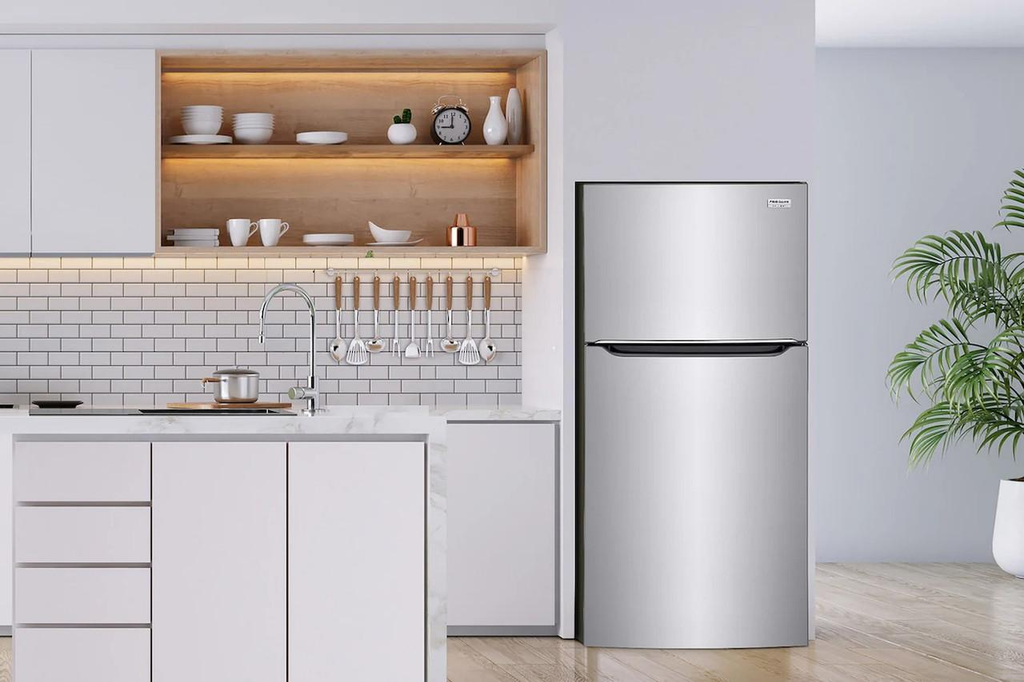
    Stainless steel top-freezer refrigerator in a modern kitchen
    Refrigerators run throughout the day, but their compressors cycle on and off. Annual energy consumption provides a more useful estimate than assuming constant full-power operation.

    Already know your refrigerator’s annual energy consumption? Use our free calculator to find out what it costs at your electricity rate.

    How many kWh does a refrigerator use?

    A refrigerator is connected to electricity 24 hours a day, but that doesn’t mean its compressor runs continuously. The compressor switches on and off as needed to maintain the correct temperature.

    That’s why multiplying the compressor’s rated wattage by 24 hours can give you a misleading estimate.

    For example, the ABL AREF18S has a certified annual consumption figure of 360 kWh. Here’s how that translates into average energy use and electricity costs.

    PeriodAverage electricity useEstimated cost in Texas
    Daily0.99 kWh$0.16
    Monthly average30 kWh$4.77
    Yearly360 kWh$57.28

    These are average estimates based on annual certified energy use and the August 2026 Texas electricity rate. Your daily consumption may vary with room temperature, door openings, and refrigerator settings.

    Where to find your refrigerator’s annual kWh

    The easiest way to estimate how much electricity your refrigerator uses is to check its EnergyGuide label.

    In the United States, many refrigerators come with a yellow EnergyGuide label showing estimated annual electricity use and energy cost. If you no longer have the label, look for the complete model number inside your refrigerator and check the manufacturer’s specifications.

    Here’s an example of what you should look for.

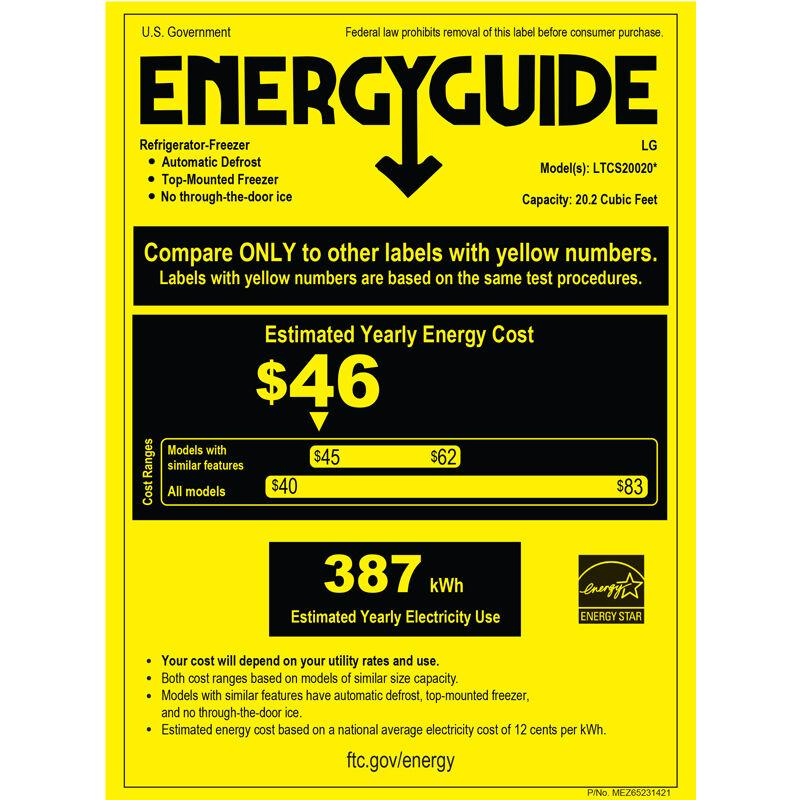
    LG EnergyGuide label showing 387 kWh of estimated yearly electricity use and 46 dollars of estimated yearly electricity cost
    Example EnergyGuide label for an LG refrigerator: estimated annual electricity use is 387 kWh. The $46 annual cost uses the label’s reference electricity rate of 12 cents/kWh.

    387 kWh: The most important number

    Look near the bottom of the yellow label. You’ll see 387 kWh — Estimated Yearly Electricity Use.

    This is the estimated amount of electricity the LG refrigerator shown on the label consumes over a year under standardized test conditions.

    If this were your refrigerator, you could enter 387 kWh/year into the PowerPriceHub electricity calculator.

    $46 per year: Why your actual cost may be different

    The label also shows an estimated yearly energy cost of $46. However, this figure is calculated using a reference electricity price of 12 cents per kWh, as noted in the fine print.

    If your electricity rate is higher, your estimated running cost will also be higher. That’s why using the annual kWh figure with your own utility rate is more useful than relying on the dollar amount printed on the label.

    Note: This LG EnergyGuide label is a separate example from the ABL refrigerator used earlier. Different models have different annual energy consumption figures.

    How much does a refrigerator cost to run in Texas vs. California?

    Even if two households use the exact same refrigerator, their electricity bills can be different because electricity prices vary by state and utility provider.

    According to the August 2026 EIA residential electricity price data used by PowerPriceHub, the statewide averages were $0.1591/kWh in Texas and $0.2975/kWh in California.

    Let’s compare two refrigerators with documented annual energy consumption figures.

    Refrigerator modelAnnual kWhTexas/yearCalifornia/year
    ABL AREF18S360$57.28$107.10
    Absocold ARD104AB21R/L242$38.50$72.00

    Important: These are different types of refrigerators. The ABL is a full-size refrigerator, while the Absocold is a much smaller hospitality refrigerator. The table illustrates electricity cost calculations, not a like-for-like comparison of refrigerator efficiency.

    Take the ABL example: using 360 kWh/year costs approximately $57.28 in Texas or $107.10 in California at these average rates. The refrigerator’s assumed energy consumption doesn’t change between the two examples — only the price of electricity does.

    Your actual electricity tariff may be different from these state averages. To get an estimate for your own refrigerator, enter its annual kWh and your electricity rate into our calculator.

    How can I measure my refrigerator’s actual electricity use?

    EnergyGuide labels provide estimates under standardized conditions. But what if you want to know how much electricity your own refrigerator actually consumes?

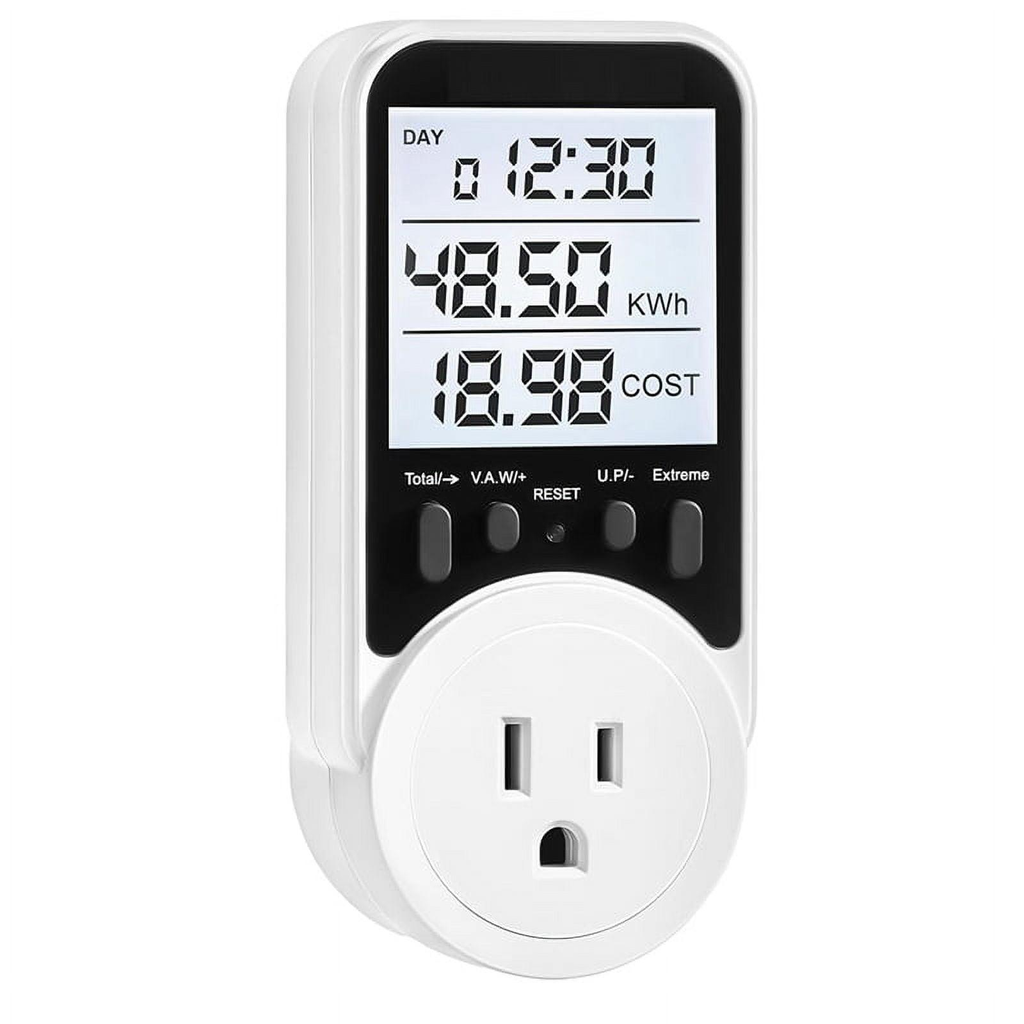
    One option is to use a compatible plug-in electricity consumption meter, sometimes called a kWh meter or energy monitor.

    Digital plug-in electricity consumption meter with a display showing accumulated energy use in kWh
    Example plug-in energy meter. A cumulative kWh reading lets you measure electricity consumption over time. The display is illustrative and does not represent a measurement of the refrigerators discussed in this article.

    How to measure your refrigerator’s kWh

    1. Choose an electricity meter compatible with your refrigerator’s electrical requirements.
    2. Follow the meter and refrigerator manufacturers’ connection instructions.
    3. Record the energy consumption in kWh over several normal days, preferably a week or longer.
    4. Divide the measured kWh by the number of days.
    5. Multiply the average daily consumption by 365 to estimate annual electricity use.

    For example, if your refrigerator consumes 7 kWh over seven days, its measured average is 1 kWh per day. That would suggest approximately 365 kWh per year if the same daily average continued throughout the year.

    Remember that this is an estimate. A week of unusually hot weather or frequent refrigerator use might not represent an entire year. Avoid treating a short measurement as an exact yearly figure.

    How to reduce refrigerator electricity costs

    If your refrigerator is consuming more electricity than expected, there are a few things worth checking before buying a replacement.

    • Check temperature settings: Keep the refrigerator and freezer at appropriate food-safe temperatures.
    • Inspect door seals: Damaged or loose seals can allow warm air inside.
    • Allow ventilation: Follow the manufacturer’s recommended installation clearances.
    • Reduce unnecessary door openings: Frequent openings make the cooling system work harder.
    • Compare annual kWh before upgrading: Use verified energy labels for similarly sized refrigerators.

    Frequently asked questions

    Does a refrigerator consume electricity all day?

    A refrigerator stays powered throughout the day, but its compressor normally cycles on and off. Its actual electricity consumption depends on how often and how long the cooling system needs to operate.

    Can I calculate refrigerator electricity cost using watts?

    Yes, if you know the actual power draw and operating time. However, annual kWh figures or measured consumption are generally more useful because refrigerators do not run at one constant power level all day.

    Is the cost printed on EnergyGuide my actual electricity cost?

    Not necessarily. EnergyGuide dollar estimates use a stated reference electricity price. Your cost depends on your own utility rate and actual energy use.

    Find out what your refrigerator costs to run

    Now you know how to find your refrigerator’s annual electricity consumption, read an EnergyGuide label, and measure actual energy usage.

    The next step is to use your own electricity rate. Enter your refrigerator’s annual kWh into PowerPriceHub to estimate your daily, monthly, and yearly running costs.

    Need help finding your electricity rate? Read how to calculate an appliance’s electricity cost from your bill, or learn more about our calculation methodology.

    Sources

  • How to Calculate an Appliance’s Electricity Cost From Your Bill

    Ever wondered how much your refrigerator, heater, or other appliance actually adds to your electricity bill? You can work it out using just two numbers: how much electricity the appliance uses and how much your utility charges per kilowatt-hour (kWh).

    The challenge is finding the right numbers. A typical electricity bill has several different charges, and an appliance’s energy label doesn’t always show what you’ll actually pay.

    In this guide, we’ll show you exactly where to look, which charges to include, and how to estimate your appliance’s running cost using your own electricity rate.

    The simple electricity cost formula

    Electricity cost = Energy used (kWh) × Electricity rate ($/kWh)

    For example, an appliance using 10 kWh at an electricity rate of $0.20/kWh costs $2.00 to operate. If you only know its power in watts, you can calculate energy consumption using:

    Energy (kWh) = Watts × Hours of use ÷ 1,000

    Already know your electricity rate and appliance consumption? Skip the manual calculation and get an estimate using our free tool.

    Step 1: Find your real electricity rate on your bill

    Before calculating the cost of an appliance, you need to know what you’re paying for electricity. This sounds simple, but many U.S. electricity bills contain separate supply charges, delivery charges, and fixed fees.

    Take a look at the example electricity bill below. We’ve highlighted the important sections to show which numbers matter when calculating appliance running costs.

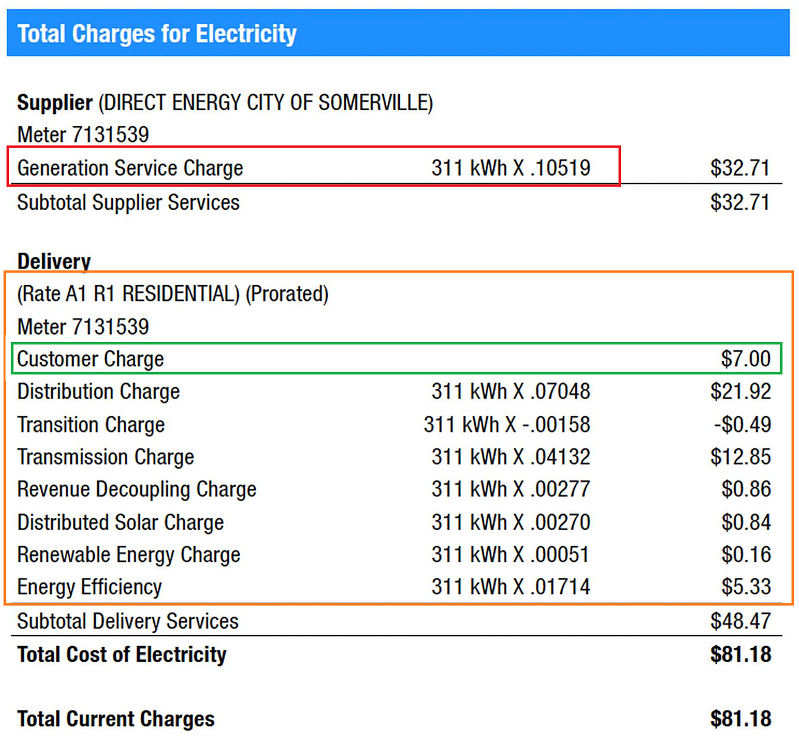
    Annotated electricity bill highlighting the supply charge in red, delivery charges in orange and fixed customer charge in green
    Example electricity bill: the red, orange and green boxes identify the charges you need to understand before calculating an appliance’s electricity cost.

    Red box: What you pay for electricity supply

    The red box highlights the Generation Service Charge. In this example, the household consumed 311 kWh, and the electricity supply price was $0.10519 per kWh.

    That means the supply portion of the bill came to approximately $32.71. However, this is not necessarily the full price of using electricity because delivery charges may also apply.

    Orange box: Delivery and other electricity charges

    The orange box highlights the delivery section. It includes charges for electricity distribution, transmission, and other utility services.

    Notice that several rows use the same 311 kWh consumption figure but multiply it by different rates. These are charges linked to electricity usage.

    Adding the applicable variable delivery charges in this example, including the negative transition adjustment, gives $0.13334 per kWh.

    Be careful: the orange section also contains the green fixed charge. You should not include that fixed amount when adding up the variable per-kWh rates.

    Green box: The fixed customer charge

    The green box highlights a $7.00 Customer Charge. Unlike the other charges, this fee is not multiplied by the amount of electricity consumed.

    If you’re trying to estimate how much extra it costs to run an appliance, you would normally exclude this fixed charge. You generally pay it even if you use fewer kilowatt-hours.

    So, which rate should you actually use?

    For this sample bill, the variable electricity price is calculated by adding the supply rate and applicable variable delivery charges:

    Electricity supply$0.10519/kWh
    Variable delivery charges$0.13334/kWh
    Combined variable rate$0.23853/kWh

    For this example, $0.23853/kWh is the rate to enter into the PowerPriceHub calculator when estimating an appliance’s additional electricity cost under the same rate structure.

    You might also see people divide their entire bill by total electricity consumption. Here, $81.18 divided by 311 kWh gives about $0.261/kWh. This is a blended rate that includes the $7 fixed fee, so it can overstate the additional cost of running an appliance.

    Your own bill may be structured differently. Always check which components vary with usage. The example above illustrates one utility bill and is not a national electricity rate.

    Now that you know how to find your rate, you can use it to estimate how much your appliances are costing you.

    Step 2: Find out how much electricity your appliance uses

    Once you know your electricity rate, the next step is finding your appliance’s energy consumption. You can usually get this information in one of three ways:

    • Watts (W): Found on an appliance’s rating label or specifications. You’ll also need to estimate how many hours it operates.
    • Measured kWh: Some smart plugs, electricity meters, and appliance displays show actual energy consumption.
    • Annual kWh: Many refrigerators and other appliances have an EnergyGuide or ENERGY STAR record showing estimated yearly electricity consumption.

    For example, a 60-watt lamp used for five hours a day over 30 days consumes 9 kWh. At the sample electricity rate of $0.23853/kWh, that costs approximately $2.15 for the month.

    Appliances that cycle on and off, such as refrigerators and air conditioners, need more care. Their rated wattage multiplied by 24 hours may not reflect their real energy usage. A measured kWh value or an appropriate annual energy estimate is often more useful.

    Step 3: Understand the EnergyGuide label

    In the United States, many household appliances display a yellow EnergyGuide label. This label can save you time because it provides an estimated yearly electricity consumption figure.

    Here’s a refrigerator label showing exactly what to look for.

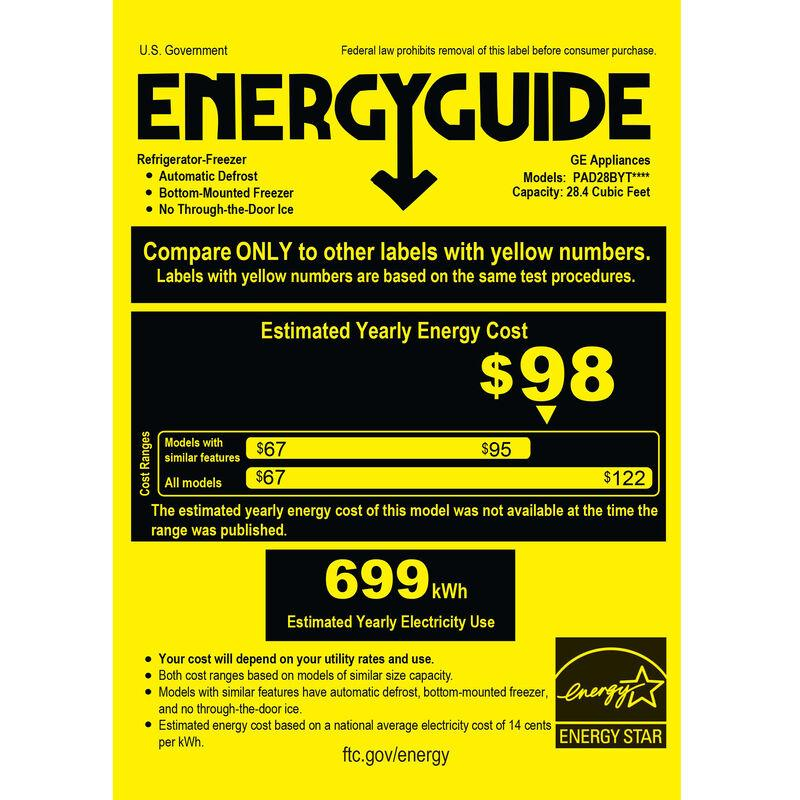
    Yellow EnergyGuide refrigerator label displaying 699 kWh estimated yearly electricity use and 98 dollars estimated annual energy cost
    EnergyGuide example: the refrigerator’s estimated annual electricity use is 699 kWh. The $98 estimated cost uses a reference electricity rate, not your personal utility rate.

    699 kWh: The number you should look for

    Near the bottom of the label, you’ll see 699 kWh — Estimated Yearly Electricity Use.

    This is the annual energy consumption estimated under standardized testing. You can multiply it by your own electricity rate to estimate the yearly operating cost.

    $98: Why your actual cost may be different

    The label also shows an estimated yearly energy cost of $98. But the fine print explains that this estimate uses an electricity rate of $0.14/kWh.

    What happens if your electricity costs more? Using the $0.23853/kWh variable rate from our sample bill, the same refrigerator’s estimated annual cost becomes:

    699 kWh × $0.23853 = $166.73 per year

    That’s why the electricity rate on your own bill matters more than the estimated dollar amount printed on the appliance label. Actual appliance consumption can also differ from standardized test results.

    Step 4: Calculate your appliance’s cost with PowerPriceHub

    You’ve found the two numbers you need: your electricity rate and your appliance’s energy consumption. Now you can put them into the free PowerPriceHub calculator instead of repeating the calculations manually.

    The screenshot below shows the calculator’s input fields. You can select an appliance, choose how its energy consumption is measured, and enter the electricity rate from your bill.

    PowerPriceHub calculator showing electricity rate, appliance category, consumption method and energy usage inputs
    PowerPriceHub electricity cost calculator. Enter your own utility rate and appliance energy use to estimate operating costs.

    To calculate the yearly electricity cost of the refrigerator shown in the EnergyGuide label above, try these example inputs:

    LocationUse my bill rate
    Electricity rate (USD/kWh)0.23853
    Appliance categoryRefrigerator
    Consumption methodAnnual label or measured kWh
    Consumption (kWh/year)699
    Identical devices1

    These inputs produce an estimated annual electricity cost of approximately $166.73. You can replace the example figures with your actual electricity rate and the consumption from your own appliance.

    Don’t have your bill available? PowerPriceHub also provides U.S. state-average residential electricity rates to help you make an initial estimate. Your own utility rate will generally be more specific.

    What if your electricity price changes during the day?

    Some electricity plans charge different rates during peak and off-peak hours. If you’re on one of these plans, a single average rate may not accurately reflect the cost of using an appliance at a specific time.

    For a more precise estimate, calculate energy used during each rate period separately, multiply it by the corresponding electricity rate, and add the results. This is especially useful for appliances whose operating times you can control.

    Ready to find out what your appliances really cost?

    Whether you’re comparing refrigerators, checking the cost of an electric heater, or wondering how much electricity your home appliances use, the important thing is to calculate with numbers that match your own situation.

    Use your own electricity rate, choose an appliance, and explore your estimated running costs for free.

    Want to learn more? Read how much electricity a refrigerator uses or explore our calculation methodology to see how our estimates work.

    Sources and methodology

    Electricity costs in this guide are illustrative estimates. The bill example uses the rates displayed in the annotated sample bill, while the EnergyGuide calculation uses the 699 kWh/year figure printed on the refrigerator label.

    U.S. Energy Information Administration — Electricity data and average prices

    ENERGY STAR — Example refrigerator certification record