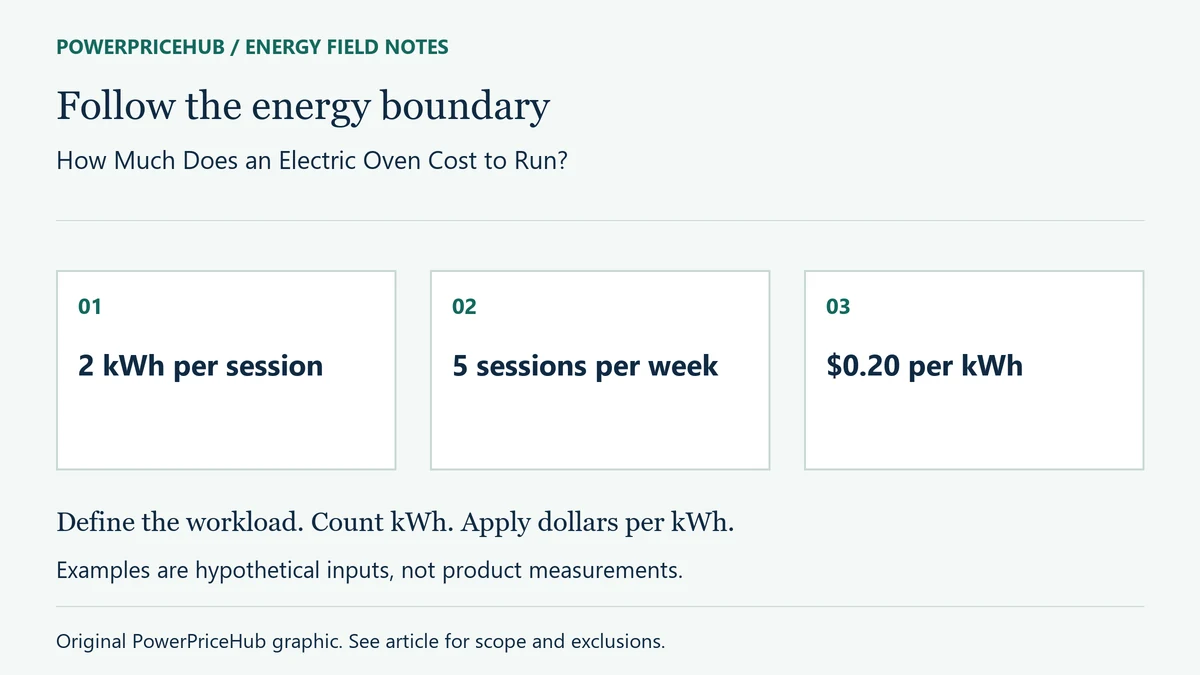
An electric oven that uses a hypothetical 2 kWh for one cooking session costs $0.40 at an illustrative $0.20/kWh. Five sessions per week annualize to 521.429 kWh and $104.29/year. That session figure should include the parts you intend to count, such as preheating and cooking. It is not a measurement of your oven or a claim that every meal uses the same energy.
The rating on a heating element is a power figure, while a meal’s consumption is energy accumulated over time. Thermostat cycling, preheat duration, temperature, cooking time, and oven size all affect how the two relate. Multiplying full rated power by the entire time displayed on a kitchen timer can misrepresent actual use.
Quick answer: estimate the complete cooking session
For a useful cost per meal, start when the oven begins preheating and stop at your chosen boundary after cooking. State whether standby and a cooling fan afterward are included. If an oven and cooktop share a circuit-level reading, separate their use or call the result a combined cooking total.
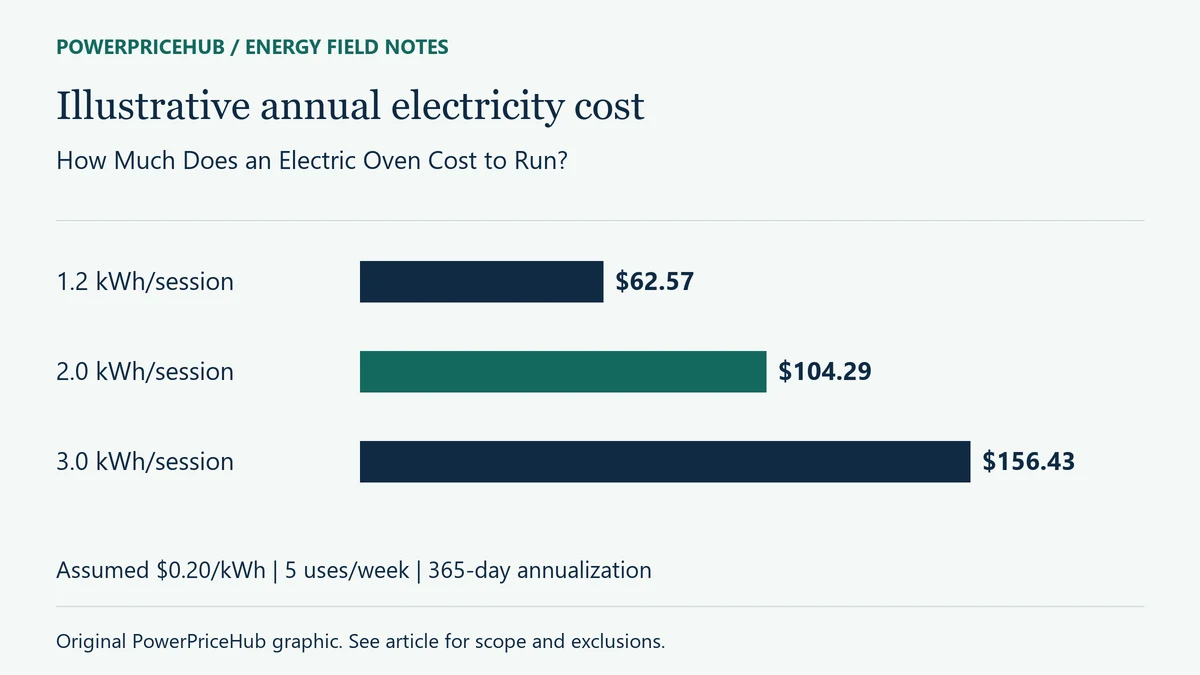
The comparison table uses hypothetical session energies, five weekly sessions, and an assumed $0.20/kWh. The rows are not efficiency classes or measured products. They exclude the cooktop, ventilation, purchase price, and any household cooling response to heat released into the kitchen.
| Illustrative scenario | Annualized kWh | Average month (USD) | Annualized cost (USD) |
|---|---|---|---|
| 1.2 kWh/session | 312.857 | $5.21 | $62.57 |
| 2.0 kWh/session | 521.429 | $8.69 | $104.29 |
| 3.0 kWh/session | 782.143 | $13.04 | $156.43 |
Why the element rating is not the meal’s kWh
A conventional electric oven uses electric resistance heat; the Department of Energy distinguishes this appliance type from other cooking products. During a session, the elements may operate at different times as the oven heats and maintains temperature. The full rated input does not have to persist continuously.
A simplified hypothetical example makes the distinction clear. A 3 kW element energized for a total of 40 minutes uses 2 kWh. An hour-long session in which that occurs does not automatically use 3 kWh. Conversely, a long preheat or additional heating elements can change the total. Only suitable measurement or documented session energy establishes the particular result.
The calculation is not a recommendation to bypass the thermostat or change electrical controls. Follow normal operating instructions. An energy estimate should never require opening the appliance, exposing wiring, or modifying its safety systems.
Separate preheating from holding temperature
Suppose preheating uses an assumed 0.5 kWh and the following cooking period uses 1.5 kWh. The meal total is 2 kWh and costs $0.40 at $0.20/kWh. If a second compatible dish can be cooked during that same already-planned session, allocate the shared energy thoughtfully rather than assigning the full preheat to each dish.
Batch cooking does not guarantee a fixed saving. Extra food can change cooking time, rack arrangement, temperature recovery, or the required program. Food safety and recipe requirements come first. The meaningful comparison is energy for the complete acceptable meal, not a lower reading obtained by undercooking food.
Temperature, time, and opening the door
Higher settings and longer sessions change the heating task, but there is no universal conversion from an extra degree to a dollar amount for every oven. Insulation, control behavior, food load, and kitchen conditions all matter. Do not publish a model-specific saving without appropriate documentation or repeatable measurement.
Use the window and oven light when they let you check progress appropriately instead of repeatedly opening the door. Keep seals and accessible surfaces maintained according to the manual. Do not use cleaning methods that damage a door seal or obstruct ventilation in pursuit of a small operating-cost reduction.
Self-cleaning is a separate operating task. If you want a yearly cooking budget, record any cleaning-cycle energy separately rather than spreading an invented allowance across meals. Likewise, a broil session should not automatically inherit a bake-session figure.
Full-size oven versus a smaller cooking appliance
A countertop oven, microwave, or another appliance may suit some meals, but the comparison must deliver the same acceptable food outcome. Do not compare reheating one portion with roasting a large meal and call the difference an efficiency result. Match the food amount, starting condition, desired finish, and food-safety requirement.
For a hypothetical comparison, one suitable alternative might use 0.6 kWh for a meal that uses 2 kWh in another appliance. At $0.20/kWh, the energy-cost difference is $0.28 for that meal. Those values are assumptions for arithmetic, not test results or a general claim about countertop appliances.
Check usable capacity before buying a second appliance. Purchase price, counter space, storage, and frequency of use belong in the decision. A rarely used device may not recover its purchase price through electricity savings alone, even if it uses less energy for one chosen task.
Find a safe basis for your household estimate
Many built-in electric ovens are hardwired or use a supply unsuitable for an ordinary 120-volt plug-in meter. Do not use improvised adapters or work inside an electrical panel. A qualified professional can advise on appropriate circuit-level monitoring; otherwise use model documentation and label the calculation’s limits.
When using a whole-home energy display, other appliances can overlap with the oven. A rise in the home’s total demand is not automatically oven-only consumption. Isolate the time period and account for other loads, or describe the reading as a household observation rather than a precise appliance measurement.
Use the electricity calculator for a documented power-and-time scenario or an energy-per-session estimate. Our bill-rate guide explains the variable electricity price, and methodology explains the units and rounding used in the examples.
Electric oven cost questions
Does a 3,000 W oven use 3 kWh every hour?
Only if it actually draws that power continuously for the full hour. Thermostat cycling and different operating phases can make session energy different from that rated-power scenario.
Should preheating be counted?
Yes, if you want the full electricity cost of a meal that requires preheating. State your measurement boundary so the session can be compared fairly with another appliance.
Does convection always save a fixed percentage?
No universal percentage is assumed here. A different program may change cooking time and temperature, but the actual energy difference needs matching meal conditions and suitable evidence.
Are self-cleaning and the cooktop included?
Not in the illustrative cooking-session table. Add separately documented energy for those functions if you want a total cooking-appliance budget.
Sources and calculation notes
Sources checked November 4, 2026. Official sources support the definitions and product information identified in the text; the hypothetical scenarios and charts are original PowerPriceHub calculations, not manufacturer tests.
DOE: household cooking-product definitions
DOE: consumer guide to kitchen appliances
Electricity-rate context: the calculator’s saved EIA residential dataset lists California at 29.75 cents/kWh ($0.2975/kWh) for August 2026, checked November 4, 2026. This is a dated state average, not your household tariff. The $0.20/kWh used in the examples above is an explicit hypothetical input. EIA electricity data and PowerPriceHub methodology.