Is a heat pump water heater cheaper to run than a standard electric water heater? In many situations, yes. A conventional electric resistance water heater generates heat directly from electricity, while a heat pump water heater uses electricity to transfer heat from surrounding air into the water.
Quick answer: In an illustrative scenario requiring 3,000 kWh of useful hot-water heat per year, a standard electric resistance heater would use 3,000 kWh of electricity at an assumed efficiency of 100%. A heat pump operating at a coefficient of performance (COP) of 2.5 would use only 1,200 kWh to deliver the same useful heat, before accounting for tank losses and other real-world factors.
At the August 2026 Texas average electricity price of $0.1591/kWh, that’s an estimated $477.30 per year for resistance heating versus $190.92 for the heat pump — a difference of $286.38 in this simplified example.
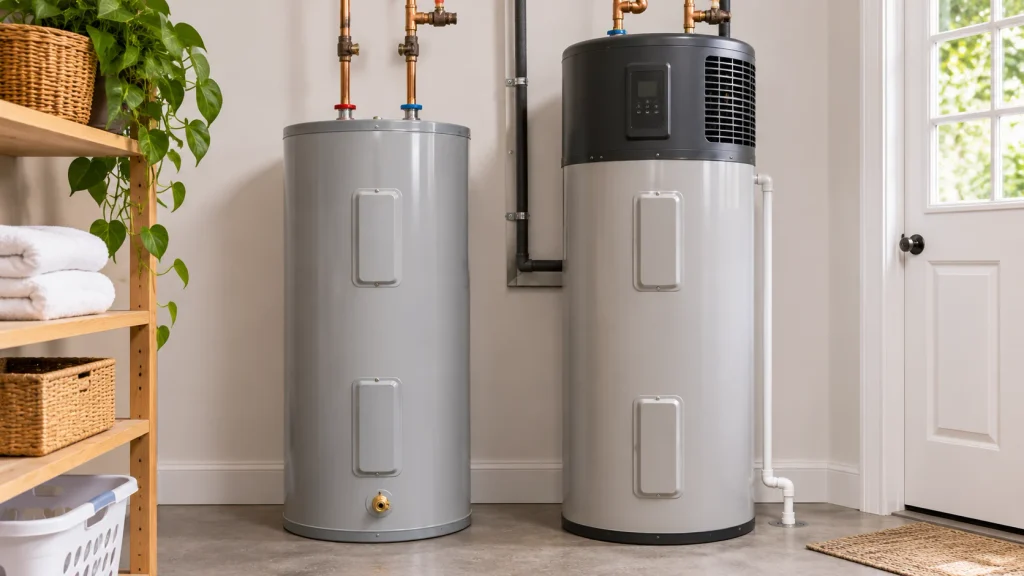
But lower electricity consumption is only part of the decision. Installation requirements, hot-water demand, local electricity prices, and upfront costs can all affect which system makes sense for your household.
How does a heat pump water heater differ from a standard electric water heater?
Both systems use electricity to provide hot water, but they obtain heat differently.
Standard electric resistance water heater
A conventional electric water heater uses heating elements inside the tank to warm the water. Electrical energy is converted directly into heat.
For a simplified comparison, assume that 1 kWh of electricity delivers 1 kWh of useful heat to the water, excluding tank and distribution losses.
Heat pump water heater
A heat pump water heater works differently. Instead of generating all its heat directly, it absorbs thermal energy from surrounding air and transfers that heat into the water tank using a refrigeration cycle.
The result is that the system can deliver more heat energy than the electrical energy it consumes. This doesn’t create energy from nothing: the additional heat comes from the surrounding air.
The diagram below shows the difference using an illustrative heat pump COP of 2.5.
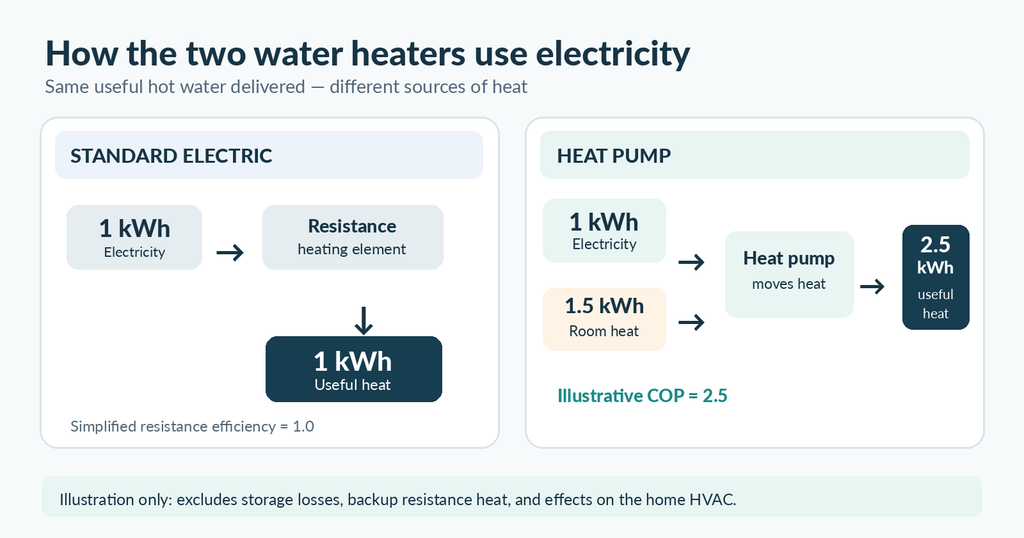
The heat pump’s efficiency is often expressed using its coefficient of performance (COP). A COP of 2.5 means the system delivers 2.5 units of heat for every unit of electricity it consumes under the assumed operating conditions.
Real-world COP changes with air temperature, water temperature, operating mode, and other conditions. Many hybrid heat pump water heaters also include electric resistance elements for periods of high hot-water demand.
Heat pump vs. electric water heater: annual running cost comparison
To compare the technologies fairly, both water heaters must deliver the same amount of useful hot water.
Let’s assume a household needs 3,000 kWh of useful water-heating energy per year. We will compare an idealized resistance system with heat pumps operating at two different COP values.
For this example, we assume identical hot-water demand, inlet water temperature, and temperature settings. We exclude standby losses, backup resistance operation, installation differences, and interactions with home heating or cooling.
All three scenarios use the August 2026 Texas residential average electricity price of $0.1591 per kWh, published by the U.S. Energy Information Administration.
| Water heater type | Useful heat/year | Electricity/year | Annual cost |
|---|---|---|---|
| Electric resistance | 3,000 kWh | 3,000 kWh | $477.30 |
| Heat pump (COP 2.5) | 3,000 kWh | 1,200 kWh | $190.92 |
| Heat pump (COP 2.0) | 3,000 kWh | 1,500 kWh | $238.65 |
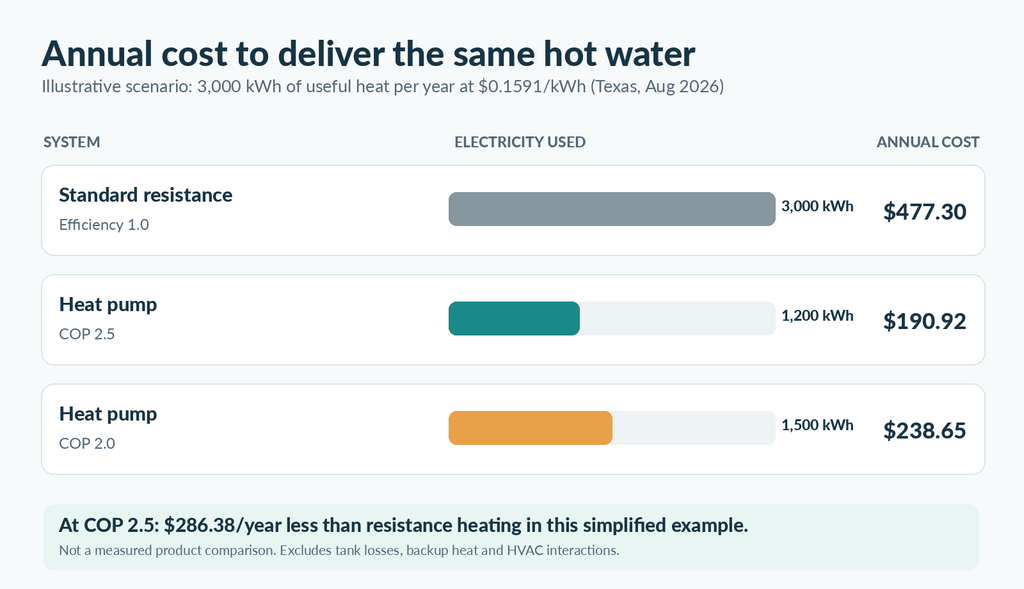
The chart below illustrates how efficiency changes electricity costs while the useful hot-water demand remains the same.
How much electricity could a heat pump save?
In the COP 2.5 scenario, the heat pump uses 1,200 kWh instead of 3,000 kWh. That’s 1,800 kWh less electricity per year, a 60% reduction in this simplified comparison.
At the Texas example rate, the annual difference is:
1,800 kWh × $0.1591 = $286.38 per year
If the heat pump operates at COP 2.0 instead, it needs 1,500 kWh per year, increasing its estimated annual electricity cost to $238.65.
These results demonstrate how efficiency affects running costs. They are not guaranteed savings for a specific household or water heater.
Is a heat pump water heater worth the higher upfront cost?
A heat pump water heater may use less electricity, but it can also cost more to purchase and install than a conventional electric resistance tank.
To evaluate whether the upgrade is worthwhile, compare the additional upfront cost with the expected annual electricity savings.
Simple payback period = Additional upfront cost ÷ Annual electricity savings
For example, suppose a heat pump water heater costs $1,000 more to purchase and install than a comparable resistance model. Using the illustrative annual savings of $286.38 from our COP 2.5 scenario:
$1,000 ÷ $286.38 = approximately 3.5 years
This is a hypothetical payback calculation, not an actual installation quote. Real payback depends on equipment prices, installation work, hot-water usage, electricity rates, maintenance, available incentives, and actual seasonal efficiency.
Check available utility and local incentives before making a purchase, and compare written installation estimates for both systems.
Which water heater is easier to install?
A standard electric resistance water heater generally has simpler air-space requirements because it doesn’t rely on surrounding air to collect heat.
A heat pump water heater needs additional consideration. Before choosing one, evaluate the following:
- Available air space: The heat pump needs sufficient airflow or an approved ducting arrangement. The exact requirements depend on the model.
- Condensate drainage: Heat pump operation can produce condensate that needs to be drained properly.
- Temperature: Cold surrounding air can reduce performance or cause some models to use backup resistance heating.
- Noise: Heat pump models contain fans and compressors, so installation location matters.
- Hot-water demand: Compare tank capacity and first-hour rating, especially for households with several back-to-back showers.
- Electrical and plumbing work: Check the manufacturer’s specifications and obtain professional installation advice.
ENERGY STAR advises checking each manufacturer’s installation instructions, ventilation requirements, and first-hour rating before choosing a model.
Can I compare real water heaters using their EnergyGuide labels?
Yes. In fact, for specific water heater models, their published annual electricity consumption figures are often more useful than assuming one COP value for every installation.
Look for the yellow EnergyGuide label or the manufacturer’s certified energy information. When comparing models, use the same hot-water draw-size class and consider comparable capacity and delivery performance.
If a label lists annual electricity consumption directly in kWh, multiply that number by your electricity rate:
Annual electricity cost = Annual kWh × Electricity rate ($/kWh)
Important: Do not divide a certified annual-kWh figure by COP again. The tested annual energy value already incorporates the equipment’s performance under the applicable test procedure.
You may also see a Uniform Energy Factor (UEF) rating. UEF is a standardized water-heater efficiency measure and is not necessarily equal to the COP used in our simplified example. Annual kWh and comparable test conditions are especially useful when estimating costs from real labels.
Calculate your water heater’s running cost with PowerPriceHub
Now that you understand the difference between resistance heating and heat pumps, you can estimate the electricity cost of either system using your own electricity rate.
To reproduce our simplified Texas comparison in PowerPriceHub, choose an annual-kWh consumption method and calculate each scenario separately:
| Electricity rate | 0.1591 USD/kWh |
|---|---|
| Electric resistance example | 3,000 kWh/year |
| Heat pump example (COP 2.5) | 1,200 kWh/year |
| Number of devices | 1 |
These are hypothetical annual consumption values, not certified model specifications. For your actual water heater, use its published annual kWh or a reliable measurement when available.
Need help finding your electricity rate? See our guide on how to calculate an appliance’s electricity cost from your bill.
Frequently asked questions
Do heat pump water heaters really use less electricity?
They generally can. Heat pump water heaters transfer heat from surrounding air instead of generating all the heat directly. Actual efficiency depends on operating conditions, settings, and how often backup resistance elements are used.
Does a heat pump water heater work in cold weather?
Yes, within the conditions supported by the specific model, but colder surrounding air can reduce efficiency. Some hybrid systems may rely more heavily on electric resistance heating when air temperatures are low or hot-water demand is high.
Can a heat pump water heater cool the room?
Yes. It removes heat from surrounding air, which can make the installation space cooler and drier. That may be beneficial in some conditions but can increase space-heating demand in colder periods.
How long does it take for a heat pump water heater to pay for itself?
There is no universal payback period. Calculate the difference in purchase and installation costs, account for any eligible incentives, and divide the net extra cost by your expected annual savings. Real-world efficiency and electricity prices affect the result.
Which electric water heater should you choose?
A heat pump water heater can significantly reduce electricity consumption when installed in suitable conditions and operated efficiently. However, a standard electric resistance model may be simpler to install in spaces where airflow, condensate drainage, or budget constraints make a heat pump impractical.
Before buying, compare annual energy use, installation requirements, hot-water delivery, and total ownership costs — not just the electricity savings shown in an example.
Use PowerPriceHub to estimate how much each option could cost at your electricity rate.
For more details about the assumptions behind our estimates, read our calculation methodology.
Sources
- ENERGY STAR — How heat pump water heaters work
- ENERGY STAR — Heat pump water heater design and installation considerations
- ENERGY STAR — Residential water heater efficiency criteria
- U.S. Department of Energy — Heat pump water heaters
- U.S. Energy Information Administration — August 2026 residential electricity prices