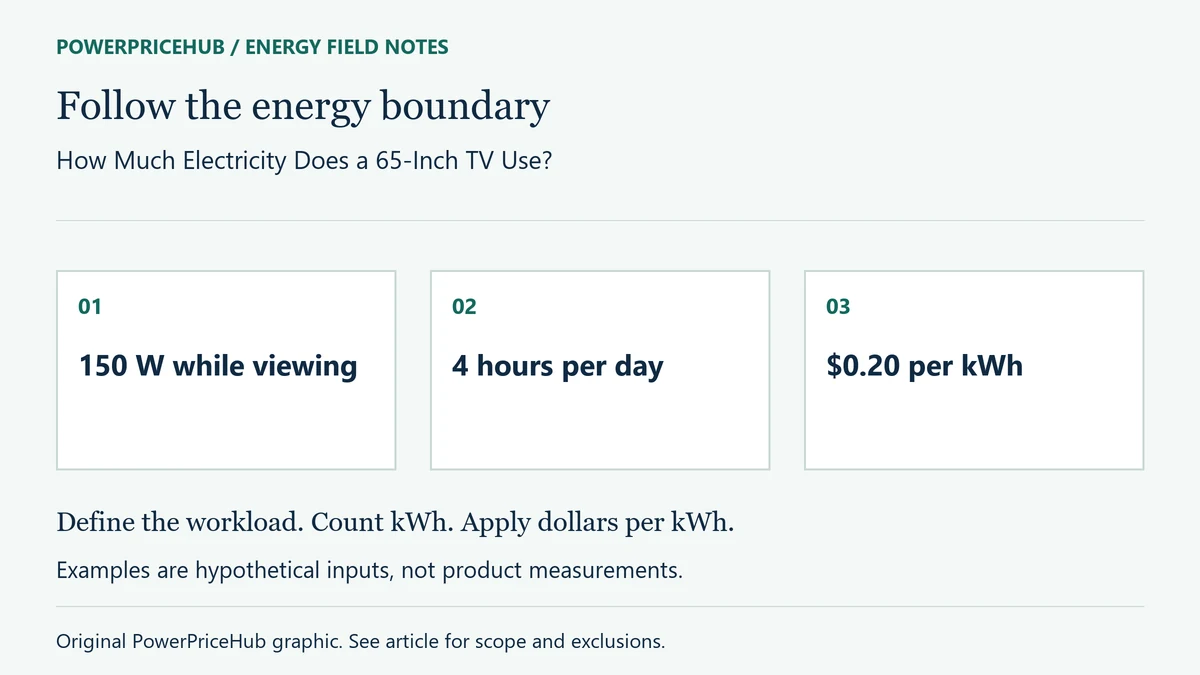
Screen size does not determine one electricity figure for every television. For a real reference point, the ENERGY STAR record for Samsung QN65S90DAF lists 251.10 kWh/year under its standardized test assumptions. At an illustrative $0.20/kWh, that becomes $50.22/year. The record identifies a 64.5-inch viewable diagonal, sold in the 65-inch class. It is one documented model, not an average for all 65-inch TVs.
Your result can differ because of viewing hours, picture settings, content, and standby features. The most useful question is not simply how many watts a 65-inch screen uses. It is how much energy your exact model uses in the modes and settings your household actually selects.
Quick answer: choose a label estimate or a viewing-hours estimate
There are two valid starting points. Use certified annual kWh unchanged when you want a standardized annual estimate. Alternatively, use a documented or measured on-mode wattage and your own viewing hours, then account for the remaining hours in standby. Do not multiply annual kWh by viewing hours a second time.
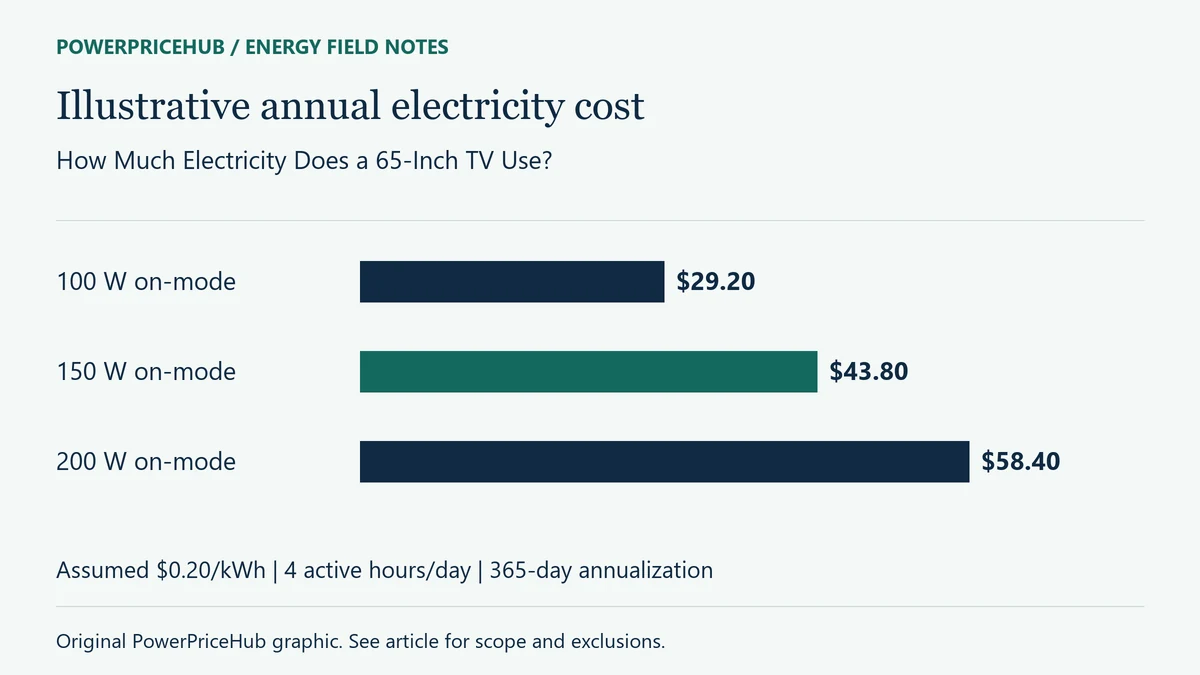
The table below is a separate hypothetical sensitivity test: three possible on-mode powers, each used four hours a day at $0.20/kWh. It excludes standby and accessories so that the effect of power is visible. None of its rows represents a measurement of the named Samsung model.
| Illustrative scenario | Annualized kWh | Average month (USD) | Annualized cost (USD) |
|---|---|---|---|
| 100 W on-mode | 146 | $2.43 | $29.20 |
| 150 W on-mode | 219 | $3.65 | $43.80 |
| 200 W on-mode | 292 | $4.87 | $58.40 |
A real model example, with its limits attached
The official record, retrieved November 4, 2026, lists 134.53 W in on mode and 0.40 W in standby when the network is not connected. It also lists 251.10 kWh as reported annual energy. Those quantities describe test conditions; they are not interchangeable statements about continuous household use.
Using the annual figure gives 251.10 × $0.20 = $50.22/year and $4.19 per average month. Using four viewing hours a day plus 20 hours of disconnected-network standby instead gives (134.53 × 4 + 0.40 × 20) ÷ 1,000 = 0.54612 kWh/day. Annualized, that is 199.3338 kWh and $39.87/year.
The two answers differ because their usage assumptions differ. That is not evidence that the record is wrong. It is a reminder to keep standardized annual estimates separate from a custom schedule. This calculation does not claim that this TV always draws 134.53 W in your home.
Why picture settings change the answer
ENERGY STAR describes automatic brightness control as a feature that changes the display’s brightness in response to room lighting. A bright room, different picture mode, or high dynamic range content can therefore make your experience differ from a simple fixed-power scenario. Compare settings using the same content and room conditions rather than one bright scene against one dark scene.
Display technology matters, but an OLED-versus-LCD label is not enough to calculate a bill. Different models, brightness targets, and content can change the comparison. This article does not rank technologies by an invented universal wattage. Use the exact model’s official record as a starting point and a measured kWh total when you need a household result.
Keep picture quality requirements consistent. A television set so dim that it is uncomfortable to watch is not delivering the same service as a properly adjusted display. Choose a comfortable home setting and then check the resulting consumption rather than treating the lowest power reading as the only objective.
Standby is small power multiplied by many hours
For an illustrative 0.5 W standby load over 20 hours daily, annual standby energy is 3.65 kWh, costing $0.73 at $0.20/kWh. A different assumed 5 W network-active load over the same hours would cost $7.30/year. These are arithmetic examples, not claims about the Samsung record or all smart televisions.
Quick-start, network wake, updates, and connected devices can affect the low-power state. Follow the manufacturer’s instructions before disconnecting power: updates, recordings, or display maintenance may need normal standby. Check each feature rather than assuming that unplugging every night is always appropriate.
Measure the entertainment system you actually use
Decide whether your measurement covers the TV alone or a power strip that also includes a game console, streaming box, soundbar, and receiver. A total-system reading is useful, but it cannot be described as television-only consumption. Label the boundary in your notes.
Use a suitable meter at an accessible outlet, within its ratings, and compare energy across several normal viewing sessions. Instantaneous wattage can fluctuate with the picture; accumulated kWh is more useful for costing a program or evening. Do not open the television or modify wiring to make a measurement.
The model explorer lets you look for documented television data. To use a custom schedule, select active power and enter viewing hours; read the displayed standby assumptions. Our methodology explains the distinction between annual-label and active-power methods, while the bill guide helps choose your electricity price.
Television electricity questions
Does a 65-inch TV use a fixed number of watts?
No. Screen size identifies a class, not a household power measurement. The model, operating mode, brightness, and content all belong in the estimate.
Should I use annual kWh or watts?
Use annual kWh for a label-based benchmark. Use watts with hours for a custom schedule. Keep the two methods separate and state which one produced your result.
Are soundbars included in the TV label?
Do not assume so. Price each separately supplied accessory or measure the whole system, clearly stating that the result includes more than the television.
Can I compare EnergyGuide dollars with my bill directly?
Only after checking the label’s price and usage assumptions. Multiplying annual kWh by your own rate provides a more relevant standardized cost, not an exact household prediction.
Sources and calculation notes
Sources checked November 4, 2026. Official sources support the definitions and product information identified in the text; the hypothetical scenarios and charts are original PowerPriceHub calculations, not manufacturer tests.
ENERGY STAR: television operating features
EPA certified record: Samsung QN65S90DAF, ID 3354311
Electricity-rate context: the calculator’s saved EIA residential dataset lists California at 29.75 cents/kWh ($0.2975/kWh) for August 2026, checked November 4, 2026. This is a dated state average, not your household tariff. The $0.20/kWh used in the examples above is an explicit hypothetical input. EIA electricity data and PowerPriceHub methodology.