Ever wondered how much your refrigerator, heater, or other appliance actually adds to your electricity bill? You can work it out using just two numbers: how much electricity the appliance uses and how much your utility charges per kilowatt-hour (kWh).
The challenge is finding the right numbers. A typical electricity bill has several different charges, and an appliance’s energy label doesn’t always show what you’ll actually pay.
In this guide, we’ll show you exactly where to look, which charges to include, and how to estimate your appliance’s running cost using your own electricity rate.
The simple electricity cost formula
Electricity cost = Energy used (kWh) × Electricity rate ($/kWh)
For example, an appliance using 10 kWh at an electricity rate of $0.20/kWh costs $2.00 to operate. If you only know its power in watts, you can calculate energy consumption using:
Energy (kWh) = Watts × Hours of use ÷ 1,000
Already know your electricity rate and appliance consumption? Skip the manual calculation and get an estimate using our free tool.
Step 1: Find your real electricity rate on your bill
Before calculating the cost of an appliance, you need to know what you’re paying for electricity. This sounds simple, but many U.S. electricity bills contain separate supply charges, delivery charges, and fixed fees.
Take a look at the example electricity bill below. We’ve highlighted the important sections to show which numbers matter when calculating appliance running costs.
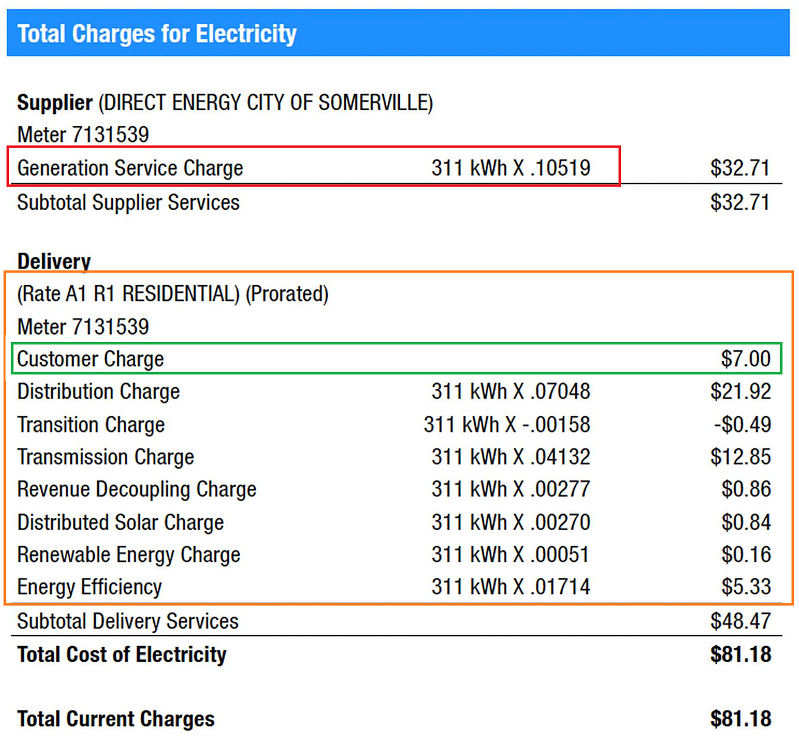
Red box: What you pay for electricity supply
The red box highlights the Generation Service Charge. In this example, the household consumed 311 kWh, and the electricity supply price was $0.10519 per kWh.
That means the supply portion of the bill came to approximately $32.71. However, this is not necessarily the full price of using electricity because delivery charges may also apply.
Orange box: Delivery and other electricity charges
The orange box highlights the delivery section. It includes charges for electricity distribution, transmission, and other utility services.
Notice that several rows use the same 311 kWh consumption figure but multiply it by different rates. These are charges linked to electricity usage.
Adding the applicable variable delivery charges in this example, including the negative transition adjustment, gives $0.13334 per kWh.
Be careful: the orange section also contains the green fixed charge. You should not include that fixed amount when adding up the variable per-kWh rates.
Green box: The fixed customer charge
The green box highlights a $7.00 Customer Charge. Unlike the other charges, this fee is not multiplied by the amount of electricity consumed.
If you’re trying to estimate how much extra it costs to run an appliance, you would normally exclude this fixed charge. You generally pay it even if you use fewer kilowatt-hours.
So, which rate should you actually use?
For this sample bill, the variable electricity price is calculated by adding the supply rate and applicable variable delivery charges:
| Electricity supply | $0.10519/kWh |
| Variable delivery charges | $0.13334/kWh |
| Combined variable rate | $0.23853/kWh |
|---|
For this example, $0.23853/kWh is the rate to enter into the PowerPriceHub calculator when estimating an appliance’s additional electricity cost under the same rate structure.
You might also see people divide their entire bill by total electricity consumption. Here, $81.18 divided by 311 kWh gives about $0.261/kWh. This is a blended rate that includes the $7 fixed fee, so it can overstate the additional cost of running an appliance.
Your own bill may be structured differently. Always check which components vary with usage. The example above illustrates one utility bill and is not a national electricity rate.
Now that you know how to find your rate, you can use it to estimate how much your appliances are costing you.
Step 2: Find out how much electricity your appliance uses
Once you know your electricity rate, the next step is finding your appliance’s energy consumption. You can usually get this information in one of three ways:
- Watts (W): Found on an appliance’s rating label or specifications. You’ll also need to estimate how many hours it operates.
- Measured kWh: Some smart plugs, electricity meters, and appliance displays show actual energy consumption.
- Annual kWh: Many refrigerators and other appliances have an EnergyGuide or ENERGY STAR record showing estimated yearly electricity consumption.
For example, a 60-watt lamp used for five hours a day over 30 days consumes 9 kWh. At the sample electricity rate of $0.23853/kWh, that costs approximately $2.15 for the month.
Appliances that cycle on and off, such as refrigerators and air conditioners, need more care. Their rated wattage multiplied by 24 hours may not reflect their real energy usage. A measured kWh value or an appropriate annual energy estimate is often more useful.
Step 3: Understand the EnergyGuide label
In the United States, many household appliances display a yellow EnergyGuide label. This label can save you time because it provides an estimated yearly electricity consumption figure.
Here’s a refrigerator label showing exactly what to look for.
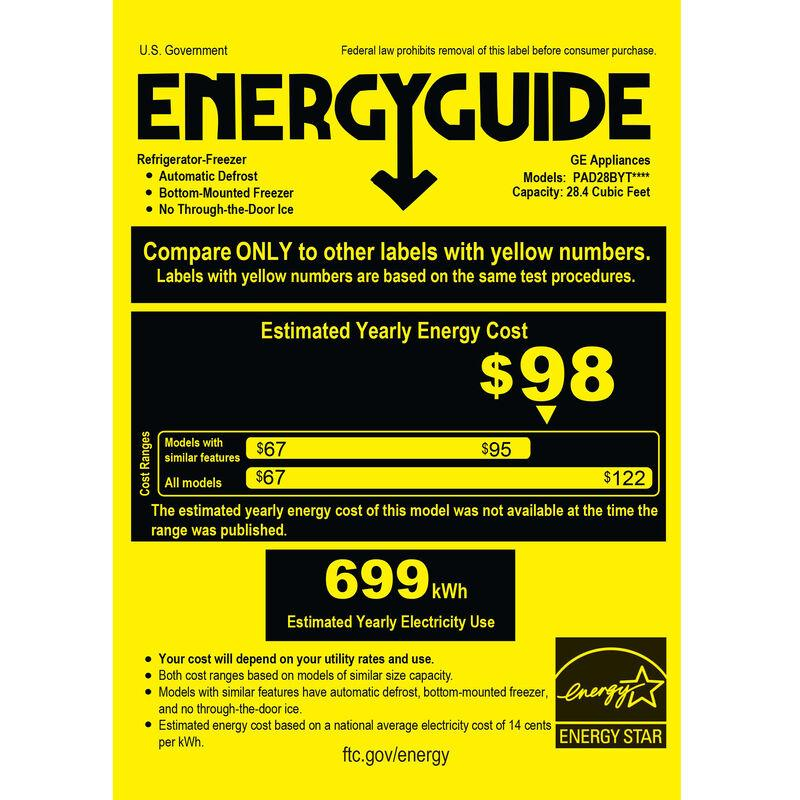
699 kWh: The number you should look for
Near the bottom of the label, you’ll see 699 kWh — Estimated Yearly Electricity Use.
This is the annual energy consumption estimated under standardized testing. You can multiply it by your own electricity rate to estimate the yearly operating cost.
$98: Why your actual cost may be different
The label also shows an estimated yearly energy cost of $98. But the fine print explains that this estimate uses an electricity rate of $0.14/kWh.
What happens if your electricity costs more? Using the $0.23853/kWh variable rate from our sample bill, the same refrigerator’s estimated annual cost becomes:
699 kWh × $0.23853 = $166.73 per year
That’s why the electricity rate on your own bill matters more than the estimated dollar amount printed on the appliance label. Actual appliance consumption can also differ from standardized test results.
Step 4: Calculate your appliance’s cost with PowerPriceHub
You’ve found the two numbers you need: your electricity rate and your appliance’s energy consumption. Now you can put them into the free PowerPriceHub calculator instead of repeating the calculations manually.
The screenshot below shows the calculator’s input fields. You can select an appliance, choose how its energy consumption is measured, and enter the electricity rate from your bill.
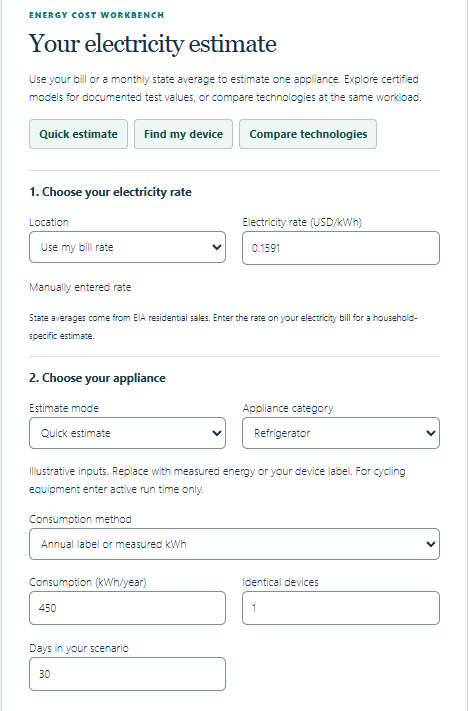
To calculate the yearly electricity cost of the refrigerator shown in the EnergyGuide label above, try these example inputs:
| Location | Use my bill rate |
|---|---|
| Electricity rate (USD/kWh) | 0.23853 |
| Appliance category | Refrigerator |
| Consumption method | Annual label or measured kWh |
| Consumption (kWh/year) | 699 |
| Identical devices | 1 |
These inputs produce an estimated annual electricity cost of approximately $166.73. You can replace the example figures with your actual electricity rate and the consumption from your own appliance.
Don’t have your bill available? PowerPriceHub also provides U.S. state-average residential electricity rates to help you make an initial estimate. Your own utility rate will generally be more specific.
What if your electricity price changes during the day?
Some electricity plans charge different rates during peak and off-peak hours. If you’re on one of these plans, a single average rate may not accurately reflect the cost of using an appliance at a specific time.
For a more precise estimate, calculate energy used during each rate period separately, multiply it by the corresponding electricity rate, and add the results. This is especially useful for appliances whose operating times you can control.
Ready to find out what your appliances really cost?
Whether you’re comparing refrigerators, checking the cost of an electric heater, or wondering how much electricity your home appliances use, the important thing is to calculate with numbers that match your own situation.
Use your own electricity rate, choose an appliance, and explore your estimated running costs for free.
Want to learn more? Read how much electricity a refrigerator uses or explore our calculation methodology to see how our estimates work.
Sources and methodology
Electricity costs in this guide are illustrative estimates. The bill example uses the rates displayed in the annotated sample bill, while the EnergyGuide calculation uses the 699 kWh/year figure printed on the refrigerator label.
U.S. Energy Information Administration — Electricity data and average prices