How much does it cost to run a 1,500-watt space heater? Whether you’re heating a bedroom, home office, or small living space, the answer depends on how long the heater actually runs and how much you pay for electricity.
Quick answer: A 1,500W electric space heater uses 1.5 kilowatt-hours (kWh) for every hour it operates at full power. At the August 2026 Texas average residential electricity rate of $0.1591/kWh, that’s approximately $0.24 per hour.
Run it at full power for two hours a day over 30 days, and your estimated electricity cost is $14.32. In California, using its August 2026 residential average rate, the same usage costs approximately $26.78.
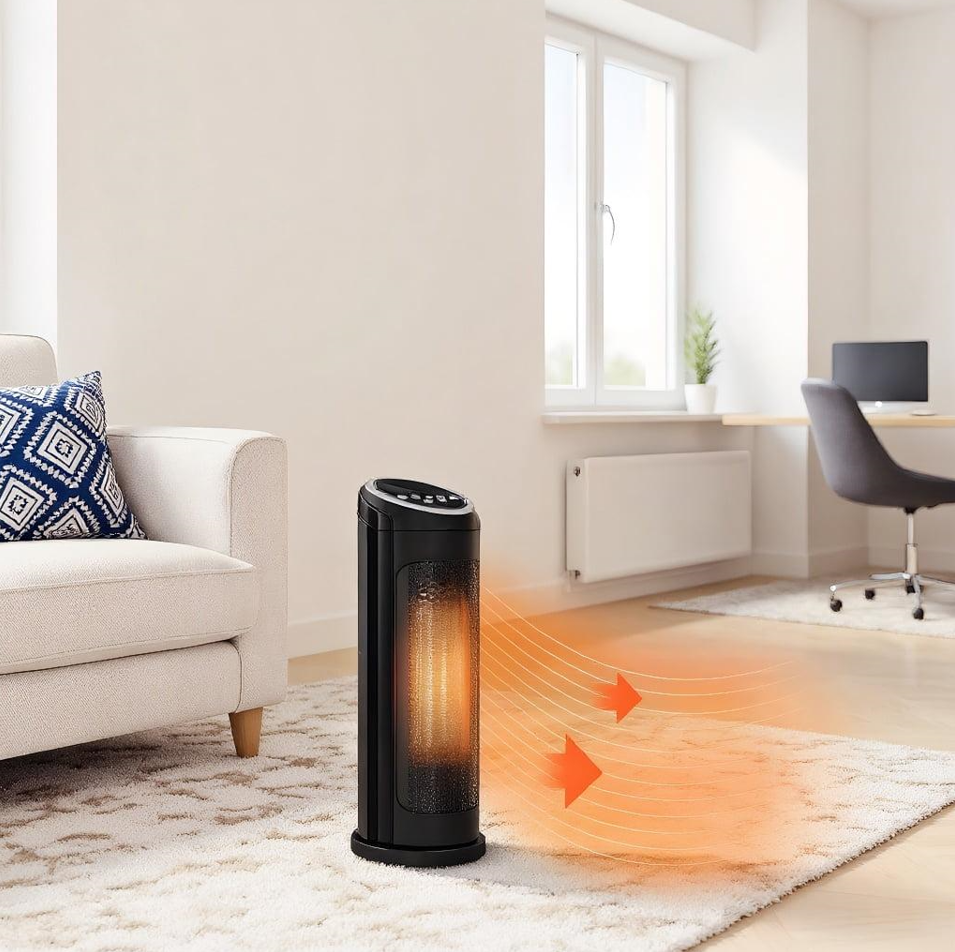
Below, we’ll break down hourly and monthly heating costs, explain how thermostats affect electricity consumption, and show you how to calculate your own costs using PowerPriceHub.
Want a personalized estimate? Calculate your space heater’s electricity cost using your own electricity rate and daily operating hours.
How much electricity does a 1,500W space heater use?
Electricity consumption is measured in kilowatt-hours (kWh). To calculate how much electricity a heater uses, convert its power from watts to kilowatts and multiply by its operating time.
Energy used (kWh) = Watts ÷ 1,000 × Hours at that power
For a 1,500-watt space heater operating continuously at full power:
- 1 hour: 1.5 kWh
- 2 hours: 3 kWh
- 4 hours: 6 kWh
- 8 hours: 12 kWh
These are full-power examples. If the heater has a thermostat that switches the heating element on and off, its actual consumption may be lower. Some heaters also have fans or controls that consume electricity.
How much does a 1,500W heater cost per month?
Electricity prices vary depending on your state, utility company, and electricity plan. That’s why two households using the same heater for the same number of hours can have different bills.
According to the U.S. Energy Information Administration (EIA), the August 2026 average residential electricity prices were:
- Texas: $0.1591/kWh (15.91 cents)
- California: $0.2975/kWh (29.75 cents)
Using those rates, here’s how much a 1,500-watt heater would cost over 30 days at different daily operating times.
| Daily hours at full power | 30-day energy use | Texas cost | California cost |
|---|---|---|---|
| 1 hour | 45 kWh | $7.16 | $13.39 |
| 2 hours | 90 kWh | $14.32 | $26.78 |
| 4 hours | 180 kWh | $28.64 | $53.55 |
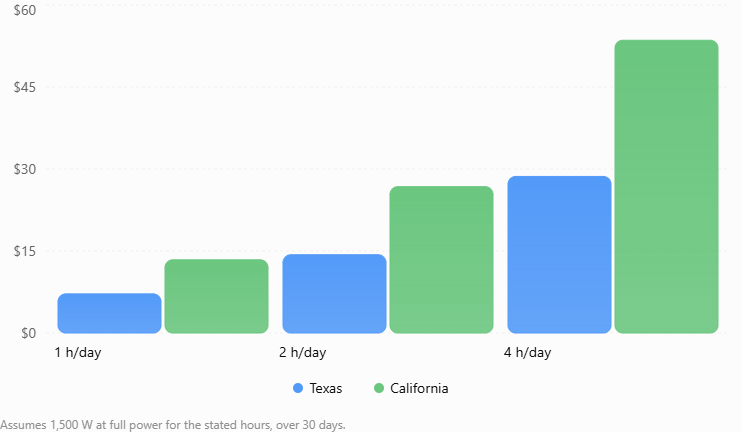
The chart below makes the difference easier to visualize. Notice how increasing the daily operating time increases energy consumption and running costs.
Example: Running a 1,500W heater for two hours every day over 30 days uses:
1,500 ÷ 1,000 × 2 × 30 = 90 kWh
At the Texas example rate, 90 × $0.1591 = $14.32 for 30 days.
If you have two identical heaters following the same schedule, their combined energy use would be 180 kWh over 30 days, costing approximately $28.64 at the same Texas rate.
These estimates use state-average residential rates from one month and assume full-power operation for the specified hours. Your actual rate and electricity consumption may differ.
Does a space heater always consume 1,500 watts?
No. A 1,500-watt rating tells you the heater’s power consumption at its rated full-power setting. It doesn’t necessarily mean the heating element draws 1,500 watts every minute the heater is switched on.
Many electric heaters include a thermostat that switches the heating element off when the room reaches the selected temperature and turns it on again as the room cools.
Example: A heater switched on for eight hours
Imagine a 1,500W heater remains switched on for eight hours, but its heating element operates at full power for only three of those hours.
The heating element’s full-power consumption would be:
1.5 kW × 3 hours = 4.5 kWh
That’s different from the 12 kWh it would use if the heating element ran at full power for all eight hours. Fans, electronic controls, or lower-power operating modes can affect the actual total.
Lowering the thermostat can reduce electricity consumption if it reduces the heating element’s operating time, but the savings depend on the room, outside temperature, insulation, and heater design.
Is it safe to leave a space heater on overnight?
Although it’s possible to calculate the electricity use associated with eight hours of operation, that doesn’t mean leaving a portable heater running while you sleep is safe.
The U.S. Consumer Product Safety Commission recommends turning portable heaters off while sleeping. Keep them at least three feet away from combustible materials such as bedding, curtains, and furniture, and plug electric heaters directly into wall outlets rather than extension cords or power strips.
Always follow the manufacturer’s safety and operating instructions for your specific heater.
Will using a space heater lower my heating bill?
A portable space heater can be useful for heating a particular area, but it doesn’t automatically reduce your total household heating expenses.
If you add a space heater while leaving your central heating system operating at the same settings, you’re adding electricity consumption rather than necessarily replacing other heating costs.
Potential savings depend on whether you’re able to reduce central heating in other areas, your existing heating system’s efficiency, and the amount of useful heat your room needs.
For example, a heat pump can deliver more useful heat per kWh of electricity than conventional electric resistance heating under suitable conditions. To compare technologies fairly, use the same amount of useful heat delivered rather than comparing electricity consumption alone.
You can explore heating technology comparisons using the PowerPriceHub electricity calculator.
Calculate your space heater’s electricity cost with PowerPriceHub
Now that you know how watts, operating hours, and electricity rates work together, you can calculate your own heating costs without doing the math manually.
The free PowerPriceHub calculator lets you enter an appliance’s electricity consumption, daily operating time, and your own electricity rate to estimate running costs.
Here’s a screenshot of the calculator. To reproduce our Texas example, use these values:
- Electricity rate: 0.1591 USD/kWh
- Appliance: Space heater
- Power: 1,500 watts
- Full-power operating time: 2 hours per day
- Days: 30
- Identical heaters: 1
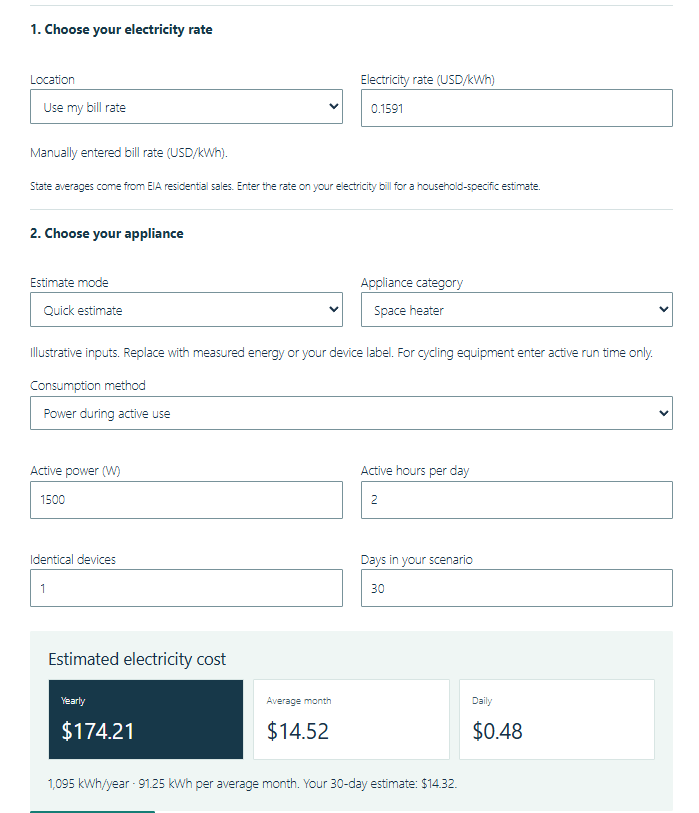
Under the example assumptions, operating one 1,500W heater at full power for two hours per day over 30 days costs approximately $14.32 at the Texas average rate used in this guide.
Replace the example electricity price with the rate from your own bill and change the operating hours to match how you use your heater.
Frequently asked questions
How much does a 1,500W heater cost to run for one hour?
At full power, it uses 1.5 kWh. That costs approximately $0.24 at $0.1591/kWh or $0.45 at $0.2975/kWh. Your electricity rate determines the exact estimate.
How much electricity does a 1,500W heater use in eight hours?
It would use 12 kWh if it operated continuously at full power for all eight hours. A thermostat-controlled heater may use less if the heating element cycles off. Portable heaters should be turned off while sleeping.
Will a lower thermostat setting reduce electricity consumption?
It can, if the lower temperature setting reduces the time the heating element is active. Actual savings depend on the heater and the conditions of the room.
Is it cheaper to run a space heater or central heating?
It depends on your central heating system, fuel prices, the area you need to heat, and how much central heating you can replace. A portable electric heater is not automatically the cheaper option.
Find out what your heater really costs
A 1,500W space heater can have a very different running cost depending on how long its heating element operates and the price of electricity in your home.
Use your own electricity rate and heating schedule to estimate your costs with PowerPriceHub.
Need help finding the correct electricity rate? Read how to calculate an appliance’s electricity cost from your bill, or review our calculation methodology.