How much does a window air conditioner add to your electricity bill? The answer depends on its energy consumption, how long it runs, and the electricity rate you pay.
Quick answer: The ENERGY STAR-certified BLACK+DECKER BD08NWES, an 8,000 BTU/h window air conditioner, has an estimated annual electricity use of 400 kWh. At the August 2026 Texas residential average electricity price of $0.1591/kWh, that works out to approximately $63.64 for the standardized test-year usage.
But how much would it cost to run an air conditioner for one afternoon, eight hours, or an entire month? Those questions require a different calculation. Let’s look at real appliance data, practical examples, and how to estimate your own cooling costs.

Already know how much electricity your air conditioner uses? Try the free PowerPriceHub electricity calculator to estimate costs using your own rate.
How much electricity does an 8,000 BTU window air conditioner use?
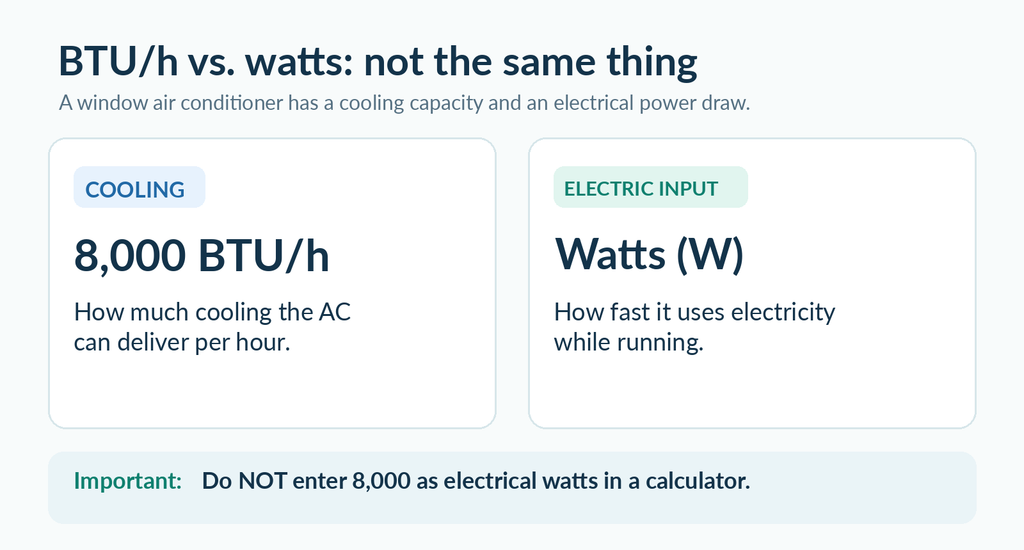
One of the most common mistakes when calculating air conditioner costs is confusing BTU/h with watts.
An air conditioner rated at 8,000 BTU/h does not necessarily consume 8,000 watts of electricity.
BTU/h measures how much heat an air conditioner can remove per hour. Watts measure electrical power drawn from the outlet. They’re related through the appliance’s efficiency, but they describe different things.
The following illustration explains the difference.
BTU/h vs. watts vs. kWh
- BTU/h: Measures cooling capacity, or how quickly the air conditioner removes heat.
- Watts (W): Measure the electrical power the unit draws at a particular moment.
- Kilowatt-hours (kWh): Measure electricity consumed over time and are used to calculate electricity costs.
For example, a window AC drawing 800 watts continuously for five hours would use 4 kWh. However, 800 watts is an illustrative input, not a verified operating wattage for the BLACK+DECKER BD08NWES.
If you know your unit’s actual power consumption, you can estimate its energy use with this formula:
Energy (kWh) = Electrical watts ÷ 1,000 × Operating hours
How much does it cost to run a window AC for 2, 5, or 8 hours?
Let’s use a hypothetical window air conditioner drawing a constant 800 watts and the August 2026 Texas average residential electricity rate of $0.1591/kWh.
These calculations show how energy costs change with operating time. They are not measurements of the BLACK+DECKER model.
| Operating time at 800 W | Electricity used | Estimated cost |
|---|---|---|
| 1 hour | 0.8 kWh | $0.13 |
| 2 hours | 1.6 kWh | $0.25 |
| 5 hours | 4.0 kWh | $0.64 |
| 8 hours | 6.4 kWh | $1.02 |
The chart below highlights the difference between two and five hours of operation at the same assumed power draw.
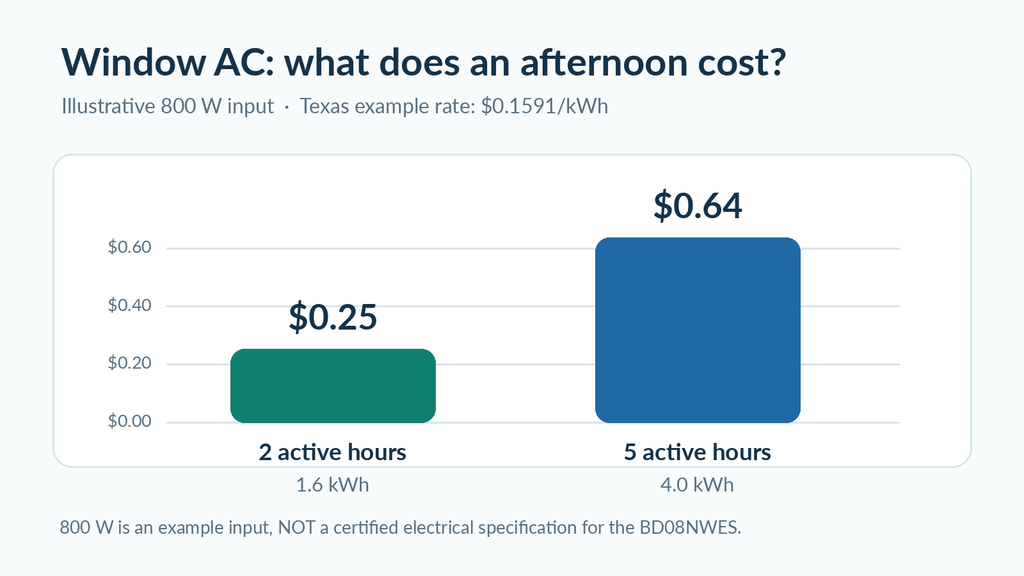
For the five-hour example, the calculation is:
800 ÷ 1,000 × 5 = 4 kWh
4 kWh × $0.1591 = $0.64
Remember that actual electricity use may be lower or higher depending on compressor speed, room conditions, fan operation, and the appliance’s measured electrical demand.
How much does a window air conditioner cost per year?
For a longer-term estimate, an ENERGY STAR-certified annual electricity consumption figure can be more useful than guessing how many hours the compressor runs.
The BLACK+DECKER BD08NWES has the following documented specifications:
| Model | BLACK+DECKER BD08NWES |
|---|---|
| Type | Window air conditioner |
| Cooling capacity | 8,000 BTU/h |
| Certified annual energy use | 400 kWh/year |
| Compressor | Variable speed |
| Combined Energy Efficiency Ratio (CEER) | 15.0 |
These specifications are documented in ENERGY STAR certification record 3387785.
To estimate annual electricity costs, multiply the standardized annual consumption by the electricity rate:
400 kWh × $0.1591 = $63.64 per year
At the August 2026 California residential average of $0.2975/kWh, the same standardized workload would cost approximately $119.00 per year.
Important: The 400 kWh figure represents standardized annual test consumption, not a guarantee of what your unit will use during an actual year. Hot weather, operating schedules, insulation, and temperature settings can change consumption significantly.
What happens if my window AC is switched on all day?
Leaving an air conditioner switched on for eight hours doesn’t necessarily mean its compressor runs at full power for eight hours.
Some air conditioners cycle their compressors on and off. Inverter models can also adjust compressor speed depending on how much cooling is needed.
The BLACK+DECKER BD08NWES uses a variable-speed compressor, meaning its electrical demand can change during operation.
For a more accurate estimate, use actual kWh readings if your unit provides them, or measure consumption over a representative cooling period using a compatible energy monitor.
For example, if a compatible meter records 6 kWh over a day, that day’s estimated electricity cost at $0.1591/kWh would be approximately $0.95.
That measured figure reflects actual energy use during the observation period rather than assuming constant compressor power.
How can I reduce my window air conditioner’s electricity cost?
You don’t always need to replace your air conditioner to improve its efficiency. A few practical changes may reduce unnecessary cooling demand.
- Choose an appropriate cooling capacity: An oversized or undersized unit may not cool the room efficiently or comfortably.
- Keep filters clean: Follow the manufacturer’s filter-cleaning recommendations.
- Reduce direct sunlight: Close blinds or curtains during hot, sunny periods when practical.
- Seal gaps around the installation: Prevent unnecessary air leakage around the window unit.
- Use sensible thermostat settings: Avoid unnecessarily low temperatures that increase cooling demand.
- Compare efficiency ratings: When choosing between appropriately sized units, check certified annual energy consumption and CEER.
Actual savings vary with the room, weather, installation, and how the air conditioner is used.
Calculate your own window air conditioner electricity cost
National and state electricity averages are useful starting points, but your own utility rate may be very different.
With PowerPriceHub, you can enter your electricity rate and appliance consumption to estimate running costs without doing the calculations manually.
For example, try using these values for the certified BLACK+DECKER annual consumption:
- Appliance: Room air conditioner
- Consumption method: Annual label or measured kWh
- Annual electricity use: 400 kWh
- Electricity rate: 0.1591 USD/kWh
- Identical devices: 1
Using those inputs gives an estimated annual cost of $63.64. Replace them with your appliance’s actual energy consumption and the electricity rate from your bill.
Frequently asked questions
Does an 8,000 BTU air conditioner use 8,000 watts?
No. The 8,000 BTU/h figure represents cooling capacity, not electrical power consumption. To calculate electricity use, find electrical watts or measured kWh.
Is it expensive to run a window AC all night?
The cost depends on electricity consumption over the night. A thermostat-controlled or inverter unit may reduce compressor power as the room cools, so eight hours switched on doesn’t necessarily equal eight hours at full electrical power.
Can I use annual EnergyGuide consumption to calculate one day’s cost?
You can divide an annual value by 365 to obtain a mathematical daily average, but this does not predict the cost of a particular hot day. Cooling electricity use varies with the season and weather.
Should I choose the window AC with the lowest annual kWh?
Not automatically. First choose a unit with cooling capacity suitable for your room. Then compare energy consumption and efficiency among models that provide similar cooling performance.
Find out how much your air conditioner really costs
The easiest way to estimate your window air conditioner’s electricity cost is to use its documented or measured energy consumption and the electricity rate you actually pay.
Enter your numbers into PowerPriceHub to estimate your running costs.
Need help finding your electricity rate? Read how to calculate an appliance’s electricity cost from your bill or learn more about our calculation methodology.